Pakistan’s leaders hail first astronaut aboard Chinese craft: ‘Proud one of us has gone into space’
 British tourist travels 29 hours from Mumbai to Amritsar for ₹5,461, rates Indian Railways 10/10 | Viral video
 The Supreme Court will decide whether assault weapons bans violate the Second Amendment
 A Critic of Beijing Falls Short in Taiwan’s Key Mayoral Election
 EPA says no rise in contamination after Army detonates lead azide stockpile in Iowa
Puerto Rico deploys home battery network to stabilise
**
Puerto Rico deploys home battery network to stabilise - AI News Breaking
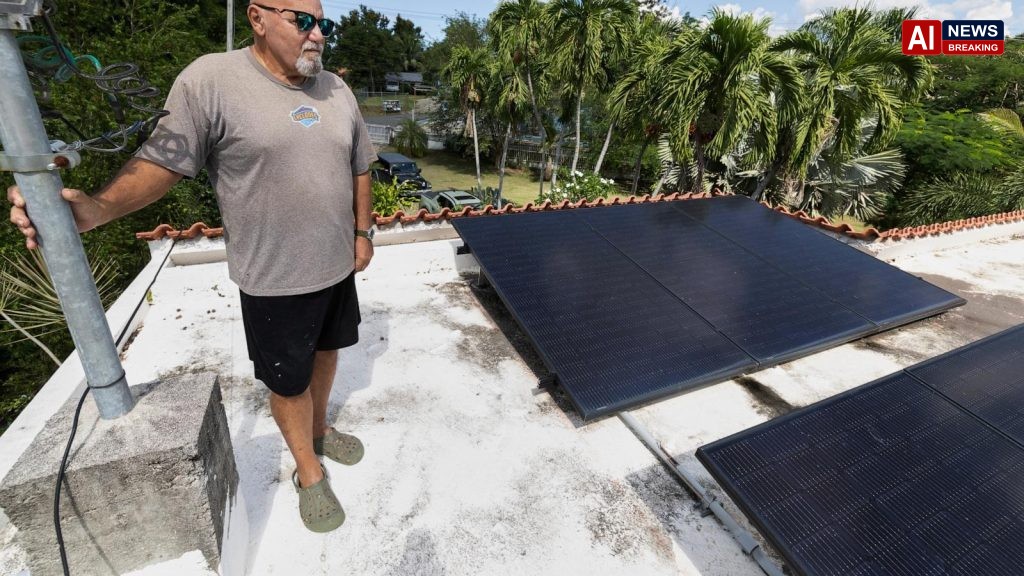
After a devastating hurricane last year, Puerto Rico’s power grid remains fragile, its capacity stretched to the limits of its aging infrastructure. Yet, a quiet revolution is underway, powered not by new power plants but by a network of home batteries that, when coordinated, act like a single, flexible power source. This “virtual power plant” has become a lifeline for communities still wrestling with blackouts, and it has provided the island with a new way to keep the lights on.The concept of a virtual power plant is straightforward: individual energy storage units, normally used in homes for backup power, are linked together and controlled centrally..
When the grid is under strain, the system can draw from or return power to the network as needed, smoothing peaks and filling gaps. In Puerto Rico, where the grid’s ability to respond to sudden demand or supply loss is limited, the virtual power plant offers a buffer that can prevent entire neighborhoods from plunging into darkness.Hector Ríos, a 38‑year‑old resident of San Juan, is one of the first to see the benefits firsthand. He installed a 10‑kilowatt‑hour battery system at his apartment as part of a pilot program launched by the island’s Department of Energy in partnership with a local utility..
“I used to have to worry every time there was a storm,” he says. “Now, my battery knows when to push power back to the grid, and the whole island benefits.” Ríos’s experience is echoed by thousands across the island who have joined the program, contributing to a collective reserve that can be tapped in moments of need.The pilot program began in 2022, after a series of power disruptions highlighted the need for more resilient energy solutions. The Department of Energy, led by ary Miguel Rodríguez, set an ambitious target: by the end of 2025, 20 percent of the island’s total electrical load would be managed through virtual power plant participation..
The pilot involved more than 10,000 households, each equipped with a smart inverter that could communicate with a central management system. The data collected from these units has been invaluable, allowing grid operators to model load patterns and predict where and when additional power would be required.A key component of the program’s success is its financial model. The Department of Energy offered subsidies and tax incentives to homeowners willing to install the necessary equipment..
For many, the upfront cost—often around $4,500 for a battery and installation—was offset by long‑term savings. Households could receive a monthly payment for the power they supplied to the grid, and during critical periods, they could opt to have the battery discharge at higher rates, earning extra compensation. This arrangement has turned a potential burden into an attractive investment for many families.Beyond individual households, the virtual power plant extends to small businesses and community centers, creating a diverse and robust network..
In rural areas where grid connections are unreliable, community centers equipped with batteries have become focal points for emergency services. In one instance, a center in the municipality of Naguabo supplied power to a local clinic during a two‑day outage, enabling continuous medical care. These on‑site instances illustrate how the virtual power plant can be a force multiplier during crises, offering localized resilience while still contributing to the broader grid.The system’s coordination relies on sophisticated algorithms that process real‑time data from thousands of nodes..
When a fault occurs, the central control unit can isolate the problem area, reallocate stored energy, and even temporarily bring a set of batteries online to counteract the shortfall. The process is seamless to users; the batteries act autonomously, ensuring that homeowners and businesses experience no interruption. The algorithm also considers weather forecasts, predicting when renewable sources—such as wind or solar—will be most productive, thereby optimizing when batteries charge and discharge.Critics have argued that the virtual power plant is a stopgap solution, pointing out that it does not replace the need for new generation capacity or grid upgrades..
While that is true, proponents say that the system buys valuable time. “The battery network gives us breathing room,” says Rodríguez. “It buys us time to plan and invest in the next generation of plants, whether they are gas turbines, solar farms, or offshore wind..
In the meantime, it reduces the frequency and severity of outages.” In fact, preliminary data from the Department of Energy’s reports indicate that the island’s average outage duration has fallen by 12 percent since the program’s launch.Another advantage lies in the environmental impact. Puerto Rico’s current mix of electricity sources is heavily reliant on fossil fuels, with 70 percent of generation coming from natural gas and oil. By smoothing load peaks, the virtual power plant reduces the need for emergency backup generators, which are often diesel‑powered and emit significant greenhouse gases..
Moreover, by enabling a higher penetration of renewable energy—particularly the abundant solar resources—across the island, the program aligns with the island’s climate targets. The Department of Energy has set a goal of achieving 80 percent renewable energy by 2030, and the virtual power plant is seen as a bridge toward that objective.The program’s expansion, however, has not been without challenges. Some residents have expressed concerns about data privacy, fearing that the central system could track their energy usage patterns too closely..
In response, the Department has implemented stringent data protection measures, ensuring that only anonymized consumption data is used for grid management purposes. Additionally, a small percentage of homeowners have reported difficulty in maintaining their batteries, especially in humid conditions that can accelerate battery degradation. To address this, the program includes a maintenance fund, financed by a modest surcharge on the monthly payments that beneficiaries receive.In addition to domestic concerns, the virtual power plant has drawn attention from international observers..
The International Energy Agency (IEA) praised Puerto Rico’s approach as a model for other island economies grappling with similar issues. “The island’s initiative demonstrates how distributed energy resources can be integrated to enhance resilience,” a spokesperson for the IEA said. This recognition has attracted interest from private investors, including a European battery manufacturer that is now in talks with the Department to supply larger units for future expansion.Looking ahead, the Department plans to integrate the virtual power plant with a microgrid initiative aimed at the island’s most vulnerable regions..
This microgrid will operate independently of the main grid during severe disruptions, relying on a combination of batteries, diesel generators, and solar panels. The virtual power plant will serve as the microgrid’s control hub, ensuring optimal performance and minimizing downtime. By doing so, Puerto Rico is not only addressing its current challenges but also building a more adaptable, future‑proof energy system.The success of the virtual power plant also highlights the importance of community engagement..
Regular workshops and informational sessions.
Puerto Rico’s battery‑grid partnership turns every household into a strategic asset, proving that distributed storage can buy critical breathing room while the island rebuilds its core power system. If scaled wisely, this model could become a blueprint for resilient, low‑carbon energy transitions in similarly vulnerable regions worldwide.