Pakistan’s leaders hail first astronaut aboard Chinese craft: ‘Proud one of us has gone into space’
 British tourist travels 29 hours from Mumbai to Amritsar for ₹5,461, rates Indian Railways 10/10 | Viral video
 The Supreme Court will decide whether assault weapons bans violate the Second Amendment
 A Critic of Beijing Falls Short in Taiwan’s Key Mayoral Election
 EPA says no rise in contamination after Army detonates lead azide stockpile in Iowa
International Court of Justice finds Myanmar genocide.
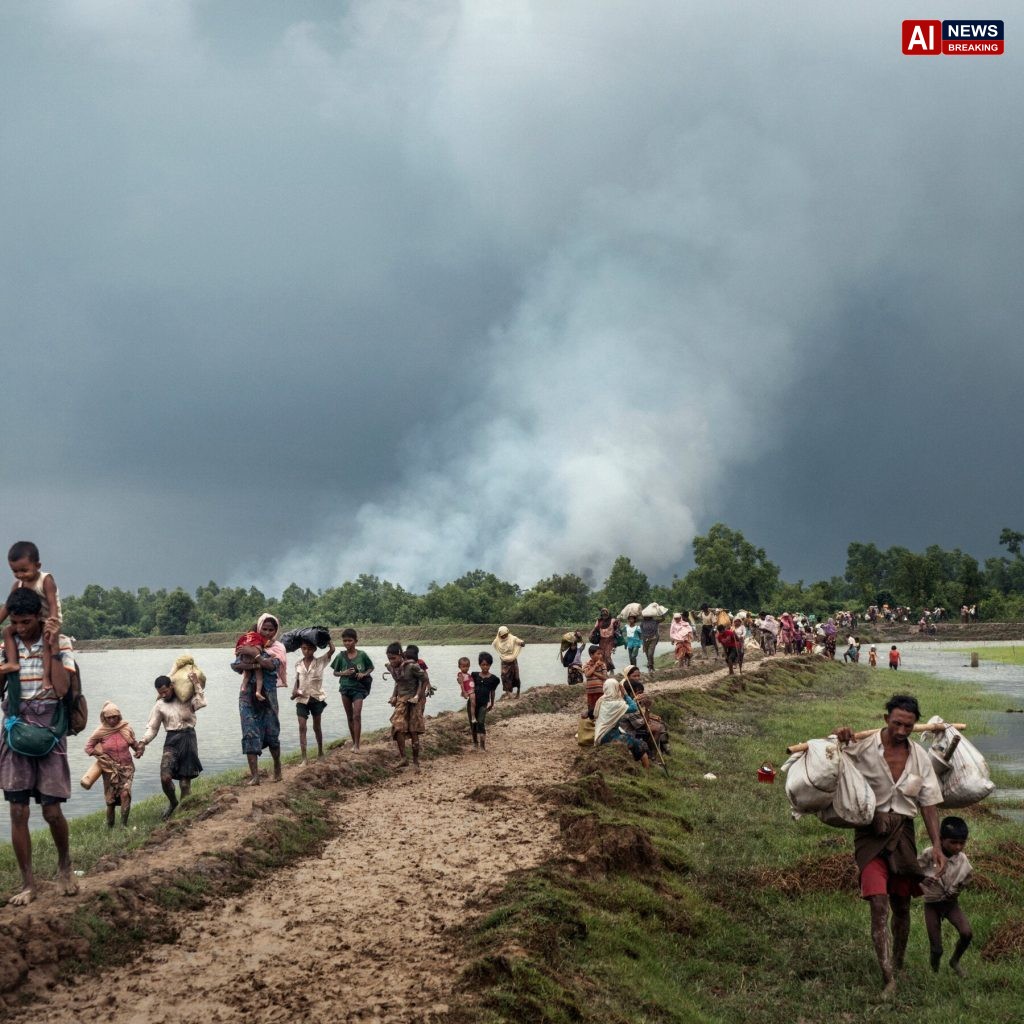
Myanmar Committed Genocide Against the Rohingya, Top Global Court Finds - AI News Breaking
international court justice finds:
The International Court of Justice issued a verdict that will reverberate through the international legal community, marking the first time a state has been formally held accountable for genocide by a court of that stature. The ruling, delivered on Wednesday, concluded that Myanmar’s military campaign in the Rakhine State, which began in 2017, constituted genocide against the Rohingya population. This finding follows years of reports from human rights organisations and the United Nations that documented systematic violence, forced displacement, and widespread destruction of Rohingya villages..
The judgment not only clarifies the legal status of the atrocities but also sets a precedent for how the world may respond to similar allegations in the future.The decision came after a lengthy case brought by the Government of the State of the Republic of the United Nations (hereafter referred to as the State) on behalf of the Rohingya, which is not recognized as a sovereign entity but whose people have long suffered discrimination and persecution. The State argued that the Myanmar government’s policies, including the deployment of the Tatmadaw, constituted a coordinated effort to exterminate the Rohingya people. In contrast, Myanmar defended its actions as necessary for national security and claimed that the violence was a response to insurgent attacks..
The court, however, found that the evidence presented was sufficient to prove the existence of genocidal intent and systematic execution of the crime.Chief Justice Danica D. highlighted that the ruling was based on an array of documentary evidence, eyewitness testimony, and satellite imagery that demonstrated the scale of the destruction. The court noted that the Myanmar military had deliberately targeted Rohingya civilians, burned villages, and forced families to flee en masse to neighbouring Bangladesh..
In addition, the court cited reports of mass graves, medical records indicating the use of chemical weapons, and the deliberate denial of humanitarian aid. The cumulative evidence satisfied the stringent criteria for genocide, which requires proof that a protected group was targeted with the intent to destroy, in whole or in part, a specific group.One of the central aspects of the ruling was the court’s emphasis on intent, the cornerstone of the definition of genocide. While some legal scholars argue that intent can be difficult to prove, the court found that the documented orders, public statements by senior military officials, and the systematic nature of the campaign provided clear evidence of purposeful intent..
The court noted that the Myanmar government’s refusal to cooperate with international investigations and its attempts to conceal the extent of the violence further corroborated this conclusion.The implications of the verdict extend beyond Myanmar’s borders. Legal scholars have pointed to the precedent it establishes for holding other states accountable for mass atrocities. The decision underscores the principle that states cannot hide behind sovereignty to carry out or facilitate genocide..
It also signals to international bodies, such as the United Nations and the International Criminal Court, that there is a growing willingness to hold state actors personally responsible for crimes of this magnitude. This shift could lead to increased pressure on other governments accused of similar crimes to submit to international scrutiny.In addition to the legal ramifications, the court’s judgment will likely influence diplomatic relations in the region. Myanmar’s relations with its neighbours, particularly Bangladesh, have already been strained by the refugee crisis..
The ruling may compel the Myanmar government to negotiate more comprehensive repatriation agreements and provide compensation to those displaced. It could also prompt a re‑examination of Myanmar’s membership in international organisations, including the Association of Southeast Asian Nations and the World Trade Organization, where the country has long sought to assert its standing.The ruling has elicited a spectrum of reactions. Myanmar’s government has dismissed the verdict as a political manoeuvre and called for an appeal..
The United Nations has praised the decision, stating it affirms the importance of international justice. Human rights groups, meanwhile, have urged that the judgement be enforced through sanctions and that the Rohingya be granted full rights to return. The international community faces the challenge of translating the court’s decision into tangible action, a process that will require coordinated efforts from governments, non‑state actors, and international institutions.The court’s decision also about the enforcement of international law..
The International Court of Justice does not have the power to impose sanctions or to enforce its rulings directly; rather, it relies on the cooperation of states and the backing of the international community. In this case, the court has called on the United Nations Security Council to consider the possibility of further measures, including the imposition of targeted sanctions against individuals responsible for the crimes. The effectiveness of such measures remains to be seen, but the court’s call marks a significant step toward ensuring that legal judgments have real-world consequences.The Rohingya community itself has expressed a mixture of relief and apprehension..
Many refugees in Bangladesh have welcomed the ruling as a moral victory, yet they remain concerned about their long‑term prospects for safety and dignity. For those who survived the violence and have returned to Myanmar, the verdict offers a sense of validation, but it also raises fears that the state might retaliate against them for speaking out. The international community will need to provide support and protection to these individuals, ensuring that their voices continue to contribute to the rebuilding of trust and justice.In the years that follow, the world will watch closely to see how this landmark ruling shapes the future of international human rights law..
The verdict not only acknowledges the suffering of the Rohingya but also reinforces the principle that genocide, regardless of the perpetrators’ status, is a crime that the international community must confront. Whether or not the ruling will spur concrete actions against Myanmar, it undeniably signals that the global judiciary is increasingly prepared to hold even powerful states to account for the most egregious violations of human rights..
Updated: November 19, 2026
Summary: The International Court of Justice has, for the first time, found Myanmar’s military campaign in Rakhine State to be genocide against the Rohingya, setting a precedent for holding states accountable for mass atrocities. The ruling, which relies on extensive documentary, eyewitness and satellite evidence, calls for UN action and sanctions, while Myanmar rejects the verdict and vows appeal, leaving the international community to determine how to enforce the judgment.
The ICJ’s verdict sends a chilling reminder that sovereignty no longer shields a state from the gravest crimes: the court has turned a political narrative into legal liability, forcing Myanmar to confront the reality it has tried to deny. This judgment may finally ignite the international community’s willingness to translate judgment into sanctions and