
 Pakistan’s leaders hail first astronaut aboard Chinese craft: ‘Proud one of us has gone into space’
 British tourist travels 29 hours from Mumbai to Amritsar for ₹5,461, rates Indian Railways 10/10 | Viral video
 The Supreme Court will decide whether assault weapons bans violate the Second Amendment
 A Critic of Beijing Falls Short in Taiwan’s Key Mayoral Election
 EPA says no rise in contamination after Army detonates lead azide stockpile in Iowa
AQI ‘poor’ in parts of Kolkata, outskirts amid Chhath celebrations
**
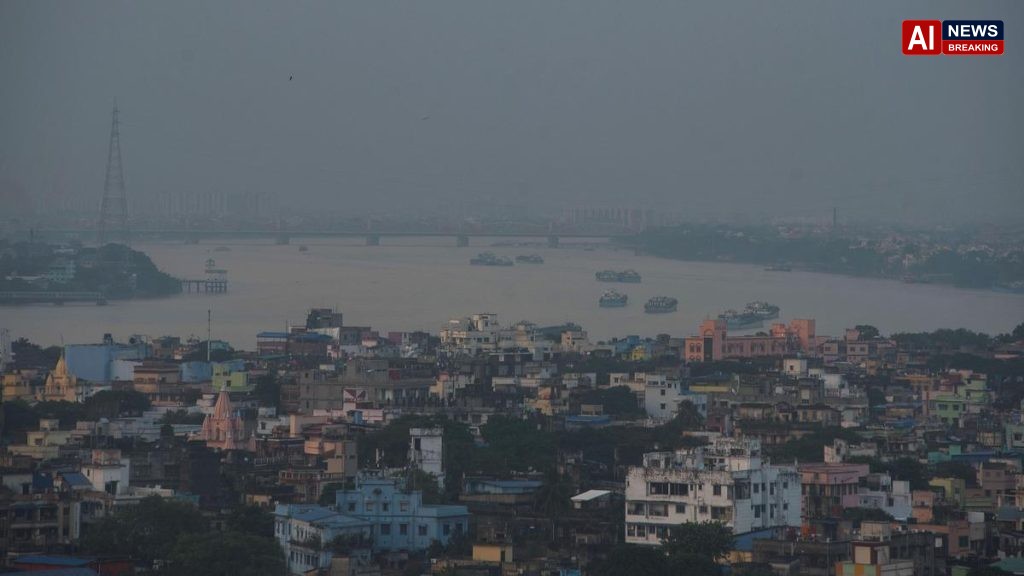
AQI ‘poor’ in parts of Kolkata, outskirts amid Chhath celebrations - AI News Breaking
poor parts kolkata outskirts:
Air quality monitoring on Saturday showed that several parts of Kolkata and its outlying suburbs were experiencing “poor” levels of pollution, with the AQI in Barrackpore on the northern fringe soaring to 230. The figure places the city’s air in the upper range of the “poor” category, according to the National Air Quality Index, which classifies readings between 201 and 300 as such. Data released by the West Bengal Pollution Control Board indicated that the spike was not isolated to Barrackpore; other peripheral zones, including parts of Dum Dum and Rajarhat, also recorded readings above 200, while the central business district hovered around the borderline between “moderate” and “poor”.The surge in pollution coincided with the celebrations of Chhath, a Hindu festival that has gained increasing prominence in the region over the past decade..
Devotees gathered along the banks of the Hooghly River and its tributaries to offer prayers to the sun god Surya, often lighting large numbers of diyas, incense sticks and firecrackers in the early morning and evening rituals. While the festival’s cultural significance is widely recognised, environmental agencies have warned that the cumulative effect of thousands of small fires, increased vehicular traffic to and from worship sites, and the use of temporary cooking stoves can contribute to short‑term spikes in particulate matter and nitrogen oxides.Experts from the Indian Institute of Tropical Meteorology noted that the timing of the festival, which falls during the pre‑monsoon season, can exacerbate the situation. “During this period the atmosphere is relatively stable, and wind speeds are low, which means pollutants tend to linger near the ground rather than dispersing,” explained Dr Ramesh Singh, a senior researcher..
He added that the region’s typical temperature inversion—where a layer of warm air traps cooler air, and consequently pollutants, close to the surface—can intensify the impact of any additional emissions. The combination of these meteorological conditions with the heightened human activity around Chhath created a perfect storm for the recorded deterioration in air quality.Health officials cautioned that an AQI of 230 falls well within the range where sensitive groups such as children, the elderly and individuals with respiratory or cardiac conditions could experience adverse effects. “People with asthma may notice increased wheezing, and those with chronic bronchitis could find their symptoms worsening,” said Dr Ananya Ghosh, a pulmonologist at a city hospital..
The West Bengal Health Department issued an advisory urging residents to limit outdoor exertion, especially during the early morning hours when the festival’s rituals begin, and to wear masks that meet the N95 standard where possible.Local authorities responded by deploying additional mobile air quality monitoring units to key locations, aiming to provide real‑time data to the public via a dedicated mobile app. The Kolkata Municipal Corporation also announced that it would increase the frequency of street cleaning in high‑traffic zones, hoping to reduce dust resuspension that can elevate PM10 levels. In addition, the corporation’s environmental wing coordinated with the police to enforce existing restrictions on the use of firecrackers, a measure that is usually relaxed during festivals but was tightened this year due to the prevailing air‑quality concerns.The government’s broader strategy to tackle chronic pollution in the Kolkata metropolitan area includes a phased ban on diesel generators, incentives for electric vehicles, and the expansion of green cover along major thoroughfares..
While these initiatives are long‑term in nature, officials said that immediate steps such as temporary traffic diversions and the suspension of construction work in the most affected zones can help lower particulate concentrations in the short term. “We are trying to balance cultural practices with public health imperatives,” said a spokesperson for the State Pollution Control Board, who declined to name specific districts.Public reaction to the advisory was mixed. Some residents expressed frustration at what they perceived as an intrusion into religious observance, posting on social media that the festival should not be curtailed for “temporary” air‑quality alerts..
Others, particularly those living in densely populated neighbourhoods already grappling with chronic smog, welcomed the warning and called for stricter enforcement of pollution controls. Local NGOs, including the Clean Air Initiative Kolkata, organised awareness drives near worship sites, distributing pamphlets that explained how to perform rituals with reduced emissions, such as using electric lamps instead of oil‑filled diyas.Economists highlighted that the episode could have implications beyond health, affecting productivity and transport. A brief study by the Indian School of Business estimated that a one‑day increase in “poor” AQI levels could lead to a 0.2 percent dip in regional GDP, mainly through reduced labor output and higher absenteeism..
The city’s logistics sector, already strained by festive traffic, reported slower turnaround times at key warehouses, prompting some firms to shift deliveries to later in the week.Looking ahead, meteorologists warned that the monsoon’s arrival later in the month could bring both relief and new challenges. While rain typically washes out airborne particles, heavy downpours can also cause water‑logged roads and increase the use of diesel‑powered pumps, adding another layer of emissions. Climate analysts stress that sustainable management of air quality will require integrating festival planning with environmental safeguards, ensuring that cultural traditions do not repeatedly clash with health objectives.As Kolkata navigates the intersection of tradition and environmental stewardship, officials reiterated that the current air‑quality warning is a snapshot rather than a permanent state..
“We have the tools and the data to act swiftly,” said the State Pollution Control Board’s director, adding that ongoing monitoring will determine whether the AQI returns to safer levels within the next 48 hours. Residents are urged to stay informed through official channels and to adopt precautionary measures, balancing reverence for Chhath with the need to protect public health..
Pollution in Kolkata spiked to “poor” levels on Saturday, with the AQI hitting 230 in Barrackpore as Chhath celebrations sparked widespread fire‑cracker use, traffic and cooking emissions. Health officials warned vulnerable groups to limit outdoor activity and wear N95 masks while authorities ramped up monitoring and enforcement to curb the short‑term air‑quality crisis.
The spike is a stark reminder that festive fervour can turn cultural heritage into a public‑health hazard when unchecked, exposing a systemic gap between traditional celebrations and environmental governance. If Kolkata’s short‑term measures remain reactive rather than proactive, the city risks turning its own rituals into recurring smog‑induced productivity drains and health crises.






