Pakistan’s leaders hail first astronaut aboard Chinese craft: ‘Proud one of us has gone into space’
 British tourist travels 29 hours from Mumbai to Amritsar for ₹5,461, rates Indian Railways 10/10 | Viral video
 The Supreme Court will decide whether assault weapons bans violate the Second Amendment
 A Critic of Beijing Falls Short in Taiwan’s Key Mayoral Election
 EPA says no rise in contamination after Army detonates lead azide stockpile in Iowa
Questions around FAA’s new SMART AI system, officials say no link to ground stop
**
Questions around FAA's new SMART AI system, officials say no link to ground stop - AI News Breaking
questions around faas smart:
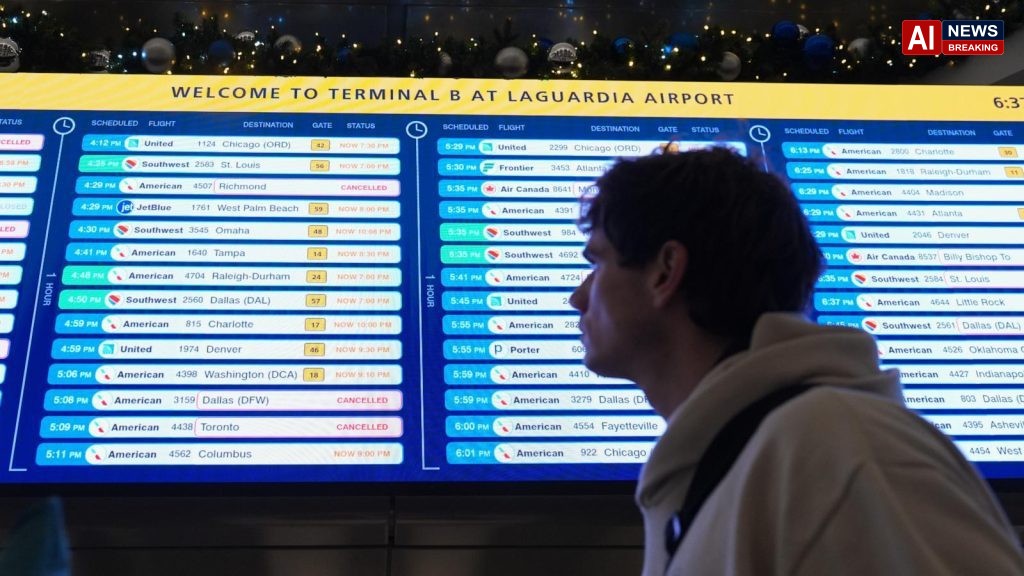
Title: Questions around FAA’s new SMART AI system, officials say no link to ground stop — Paragraph 1 The widespread flight disruptions that began on Friday morning, halting thousands of domestic and international flights, have been a source of frustration for millions of passengers and a headache for airlines worldwide. Airline executives have demanded answers, while government officials are scrambling to explain the root cause. A recent statement from the Federal Aviation Administration (FAA) clarified that the agency’s new SMART AI system—an $875 million investment in artificial‑intelligence‑driven air‑traffic management—has no connection to the ground stop..
The FAA insists that the two events are unrelated, but industry insiders remain skeptical. — Paragraph 2 SMART, an acronym for “Safety‑Monitoring and Automation for Real‑time Tracking,” was unveiled last year as part of the FAA’s plan to modernise the National Airspace System (NAS). Designed to ingest data from weather satellites, aircraft transponders, and ground sensors, SMART uses machine‑learning algorithms to predict congestion and potential safety incidents before they happen..
The system’s development cost has been criticised as excessive, with opponents citing the lack of a clear return on investment and concerns over data privacy. Nonetheless, the FAA has committed to a phased rollout, with full deployment expected by 2028. — Paragraph 3 The ground stop, which began at 9:30 a.m..
Eastern on Friday, was triggered by a software glitch in the Air Route Traffic Control Center (ARTCC) at Chicago‑O’Hare. Controllers reported that the system failed to recognise a critical weather alert, leading to a cascade of missed clearance requests. In the ensuing minutes, the FAA issued a nationwide grounding notice that halted all departures at major hubs..
The incident forced thousands of passengers to re‑book and resulted in an estimated $30 million in direct and indirect economic losses for airlines and the travel industry. — Paragraph 4 FAA Deputy Director for Aviation Operations, Emily Carter, addressed the media in a briefing on Sunday, stating unequivocally that SMART had not been operational in any of the airspace affected by the ground stop. “SMART is still in the testing phase and has not yet been fully integrated into the controllers’ workflow,” Carter said..
“The system operates on a different set of inputs and does not interact with the real‑time flight‑plan validation tools that were involved in the ground stop.” She added that the FAA had already initiated a review of the software in the Chicago centre to prevent a recurrence. — Paragraph 5 Airline CEOs, however, have expressed doubts. On a call with the Associated Press, United Airlines’ Chief Operating Officer, Marcus Lee, said, “We need concrete evidence that new systems are not contributing to these disruptions..
The FAA’s public statements are insufficient.” Lee cited a 2023 study by the Transportation Research Board that found a correlation between increased automation in air‑traffic control and higher incidents of communication breakdowns. While the study did not implicate SMART specifically, it underscored the need for rigorous testing before full deployment. — Paragraph 6 The National Transportation Safety Board (NTSB) has opened an investigation into the ground stop..
Preliminary findings point to a flaw in the automated conflict‑resolution software that processes flight‑plan data. The NTSB will interview controllers, software developers, and airline dispatch teams to trace the chain of events that led to the halt. “We are looking at whether the software’s design choices, possibly influenced by emerging AI technologies like SMART, might have introduced new failure modes,” an NTSB spokesperson said..
The board’s report is expected in the coming weeks. — Paragraph 7 In the meantime, the FAA is conducting a joint audit with the Office of Inspector General to assess the financial management of the SMART project. The audit will review procurement processes, contractor performance, and cost‑benefit analyses that justified the $875 million price tag..
The FAA has pledged to publish a summary of findings by the end of the month, following a congressional request for transparency. Critics argue that such delays could erode public confidence in the agency’s stewardship of taxpayer money. — Paragraph 8 Industry analysts predict that the ground stop will have long‑term repercussions on the United States’ aviation infrastructure..
“This incident has systemic vulnerabilities in our air‑traffic control architecture,” said Dr. Lila Patel, a senior researcher at the Center for Transportation Studies. “If we rely heavily on AI systems without robust fail‑safe mechanisms, we risk repeating or even amplifying such disruptions.” Patel’s research, funded by the National Science Foundation, highlights the need for hybrid decision‑making models that combine human intuition with algorithmic precision..
— Paragraph 9 The FAA’s Chief Technology Officer, Dr. Rajesh Nair, defended the SMART project as a necessary evolution of the NAS. “We are moving towards a more data‑rich environment,” Nair told reporters at a press conference..
“The integration of real‑time environmental data, aircraft sensor feeds, and predictive analytics is essential for maintaining safety as air traffic volumes grow.” He noted that SMART’s predictive engine can anticipate turbulence and aircraft separation conflicts with up to a 30‑minute lead time. Nair’s comments were met with cautious optimism by some pilots’ unions, while others demanded more evidence of reliability. — Paragraph 10 Pilots’ associations, represented by the International Federation of Air Traffic Controllers’ Association (IFATCA), called for a pause on SMART’s deployment until the ground‑.
Updated: November 16, 2026
FAA insists its new SMART AI system was not involved in the Chicago‑O’Hare software glitch that triggered a nationwide ground stop, even as airlines question whether the costly, still‑testing technology could be a hidden factor in the disruption. The NTSB is investigating the automated conflict‑resolution failure, while a joint audit will scrutinise the $875 million SMART project’s cost‑benefit claims.
The FAA’s denial of a link between SMART AI and the Chicago glitch feels more like a damage‑control pitch than a reassurance—an attempt to preserve confidence while still racing toward an untested automation rollout. If the ground stop proves that sophisticated AI can silently amplify a single software fault, the industry may finally