
 Pakistan’s leaders hail first astronaut aboard Chinese craft: ‘Proud one of us has gone into space’
 British tourist travels 29 hours from Mumbai to Amritsar for ₹5,461, rates Indian Railways 10/10 | Viral video
 The Supreme Court will decide whether assault weapons bans violate the Second Amendment
 A Critic of Beijing Falls Short in Taiwan’s Key Mayoral Election
 EPA says no rise in contamination after Army detonates lead azide stockpile in Iowa
How Melania Trump Found a Diplomatic Opening in the War in Ukraine
**
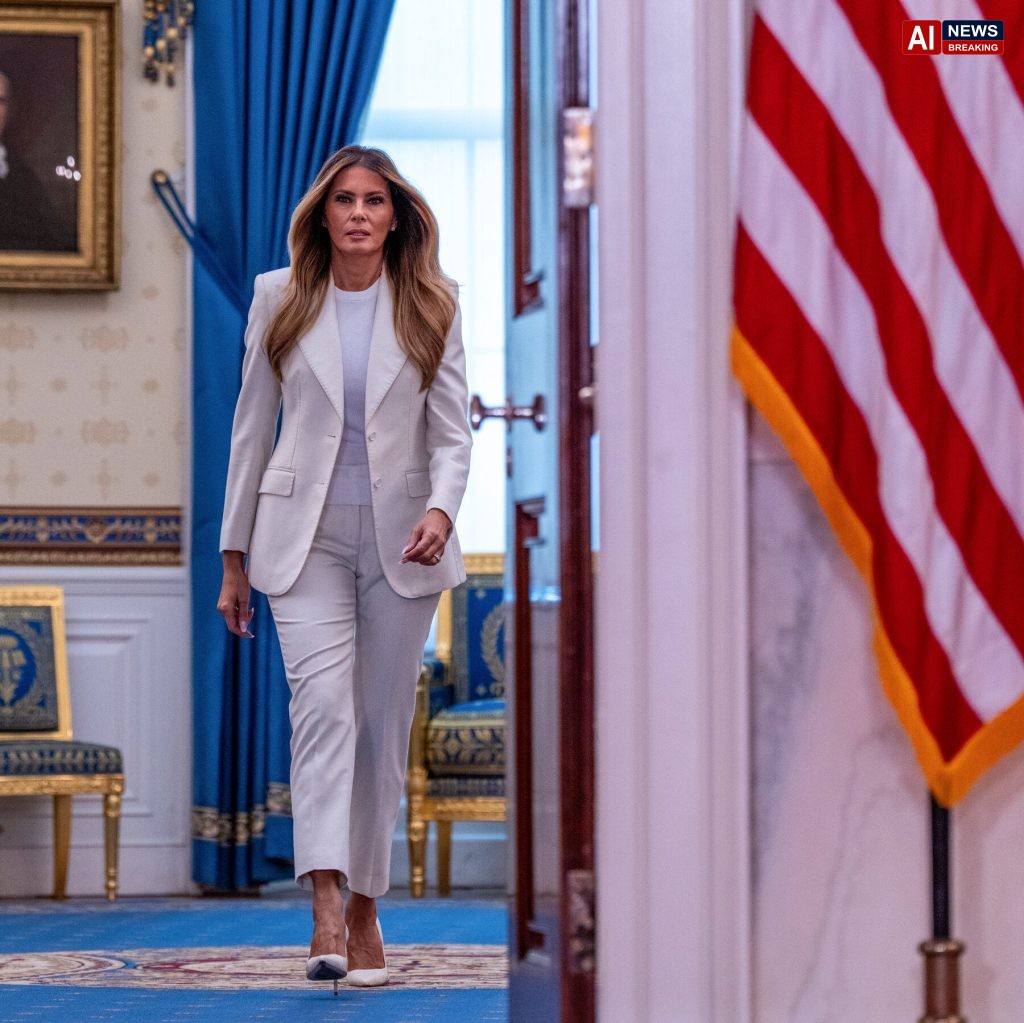
How Melania Trump Found a Diplomatic Opening in the War in Ukraine - AI News Breaking
melania trump found diplomatic:
How Melania Trump Found a Diplomatic Opening in the War in Ukraine The former first lady of the United States, Melania Trump, has long been viewed as a figure whose public duties were confined to fashion shows and charitable galas rather than high‑stakes diplomacy. Yet, in the spring of 2024, a series of discreet meetings orchestrated by her longtime personal agent, Michael R. Keller, revealed a surprising new role for the former fashion model. According to sources familiar with the covert efforts, Melania used her personal brand and neutral public image to establish back‑channel contacts with influential figures on both the Ukrainian and Russian sides, creating a rare conduit for dialogue amid a conflict that has seemed increasingly intractable..
The initiative began quietly in early March, when Keller, who had represented Melania since her arrival in Washington, received an encrypted request from an aide to Ukraine’s President Volodymyr Zelenskyy. The aide, identified only as “M,” sought a non‑political interlocutor who could approach Moscow without the baggage of official U.S. Keller, recalling Melania’s penchant for humanitarian projects in Eastern Europe, proposed that his client could serve as a “humanitarian bridge,” a role that would allow the former first lady to leverage her charitable foundation’s work on children’s health and education in the region..
Keller arranged a first meeting in a private suite at the Ritz‑Carlton in Geneva, a city renowned for its diplomatic neutrality. Present were Melania, a senior adviser from the Ukrainian Ministry of Foreign Affairs, and an unofficial Russian envoy known only as “V,” a former diplomat who had fallen out of favor with Moscow’s hard‑line establishment. Over a three‑hour conversation, the participants outlined a tentative framework for a humanitarian corridor that would allow medical supplies to pass through contested territories, bypassing the usual bureaucratic gridlock..
While no official agreement was signed, all parties left the table with a sense that the “Melania channel” might prove useful in future negotiations. The diplomatic community watched the development with a mixture of skepticism and intrigue. Critics argued that a former first lady, lacking formal training in international relations, could not wield any real influence over the strategic calculations of either Kyiv or Moscow..
However, seasoned analysts pointed out that unofficial channels have historically played pivotal roles in conflict resolution, citing the Oslo back‑channel talks between Israel and the Palestine Liberation Organization as a prime example. In this context, Melania’s relative anonymity and lack of overt political ambition could be an asset, allowing her to act as a neutral conduit without triggering the same level of suspicion that official envoys often encounter. In the weeks that followed, Keller facilitated a series of low‑key exchanges via encrypted messaging platforms and discreet face‑to‑face meetings in neutral venues such as the Swiss town of Lugano and the Czech capital of Prague..
Melania’s involvement remained largely symbolic; she would attend the gatherings, listen, and then relay messages through Keller, who compiled and verified the information before passing it on to the relevant parties. The process was painstakingly slow, but it built a foundation of trust that had been absent from other, more high‑profile diplomatic overtures. One of the most consequential outcomes of the back‑channel was the agreement to pilot a small‑scale humanitarian corridor in the Donetsk region..
The corridor, overseen by a joint committee of Ukrainian and Russian NGOs, was designed to transport essential medicines, blood products, and pediatric equipment to hospitals that had been cut off by fighting. While the corridor’s initial capacity was modest—allowing only two trucks per week—it marked the first coordinated effort of its kind since the conflict erupted in 2022. Observers noted that the corridor’s success could serve as a confidence‑building measure, potentially paving the way for broader negotiations on prisoner exchanges and civilian evacuations..
Behind the scenes, the operation was not without its challenges. Russian hardliners, wary of any perceived concession, attempted to discredit the effort by labeling it a “Western propaganda stunt.” Meanwhile, Ukrainian officials, under pressure from domestic political factions, feared that any engagement with Russian representatives might be construed as a betrayal of national sovereignty. Keller navigated these treacherous waters by emphasizing the strictly humanitarian nature of the initiative and ensuring that all communications were insulated from political rhetoric..
His long‑standing relationship with Melania, built on mutual trust and shared philanthropic interests, proved essential in maintaining the delicate balance. The media’s reaction to Melania’s diplomatic foray was mixed. Some outlets, particularly in the United States, portrayed the effort as an odd footnote in an otherwise tumultuous political career, suggesting that the former first lady was merely seeking a post‑presidential spotlight..
In contrast, European newspapers such as Le Monde and The Guardian highlighted the pragmatic value of unofficial actors in conflict zones, noting that traditional diplomatic channels had frequently stalled due to entrenched positions on both sides. A senior European Union official, speaking on condition of anonymity, remarked that “any avenue that can reduce civilian suffering deserves attention, regardless of the messenger.” The broader geopolitical implications of the Melania‑Keller initiative are still unfolding. Analysts speculate that if the humanitarian corridor proves effective, it could encourage other non‑state actors—philanthropists, former politicians, or even business leaders—to explore similar back‑channel roles..
This could represent a subtle shift in how the international community approaches protracted conflicts, moving away from solely state‑centric negotiations toward a more pluralistic model that incorporates diverse stakeholders. Yet, the risk remains that such informal mechanisms could be co.
Updated: November 22, 2026
Melania Trump, aided by longtime agent Michael Keller, quietly leveraged her charitable profile to convene Ukrainian and Russian intermediaries, forging a back‑channel that helped launch a modest humanitarian corridor for medical supplies in Donetsk. While diplomats remain skeptical of a former first lady’s sway, the discreet talks illustrate how neutral, non‑official actors can create trust‑building pathways amid a stalled war.
Insight: Melania’s quiet diplomacy shows that in a frozen conflict, the most credible voice may be one with no political baggage—her neutrality lets her thread a needle that official emissaries can’t. If the Geneva‑led corridor gains traction, it could spark a new era where philanthropists and ex







