
 Pakistan’s leaders hail first astronaut aboard Chinese craft: ‘Proud one of us has gone into space’
 British tourist travels 29 hours from Mumbai to Amritsar for ₹5,461, rates Indian Railways 10/10 | Viral video
 The Supreme Court will decide whether assault weapons bans violate the Second Amendment
 A Critic of Beijing Falls Short in Taiwan’s Key Mayoral Election
 EPA says no rise in contamination after Army detonates lead azide stockpile in Iowa
Is Mexico Stepping Up in the War on Drugs?
**
Is Mexico Stepping Up in the War on Drugs? - AI News Breaking
mexico stepping drugs:
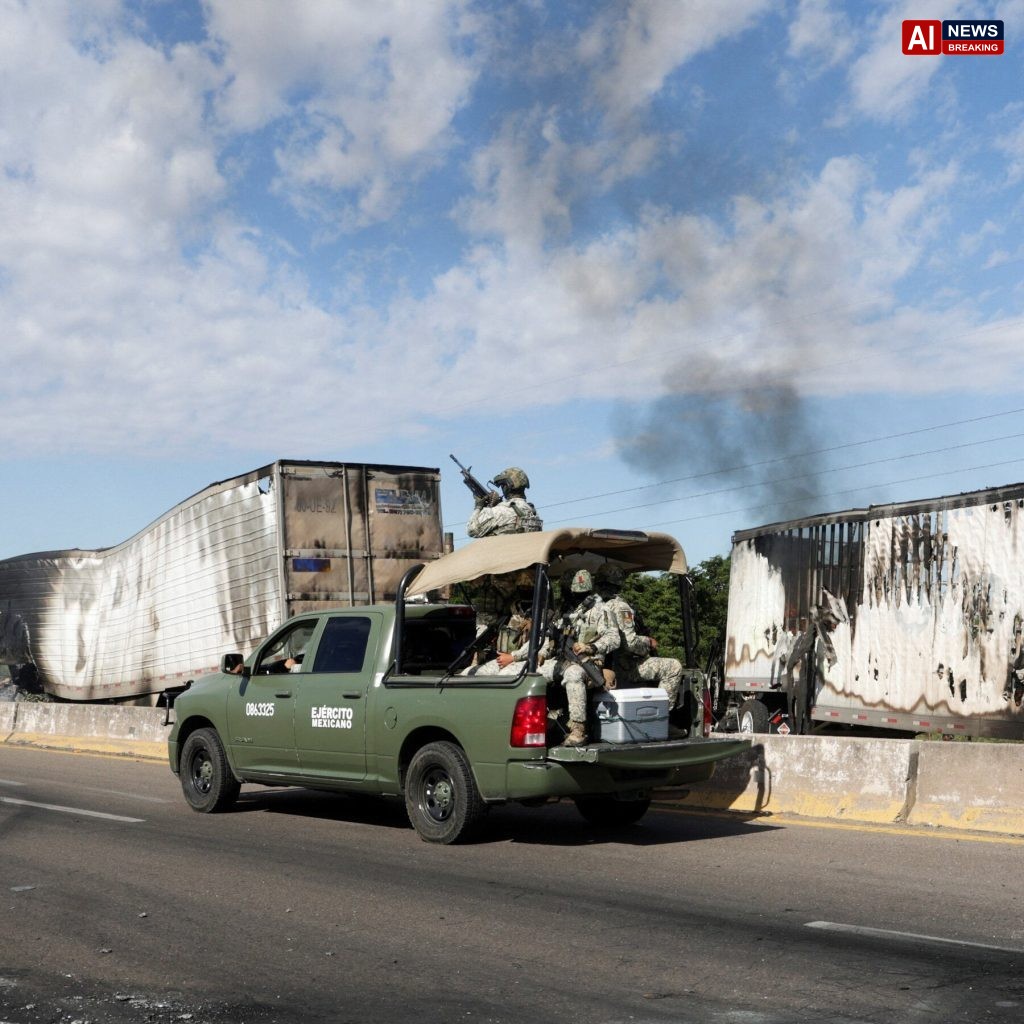
Is Mexico Stepping Up in the War on Drugs? The recent capture of three high‑profile cartel leaders – Miguel Ángel “El Gordo” Torres of the Jalisco New Generation Cartel, Carlos “El Lobo” Hernández of the Sinaloa Federation, and Ana María “La Viuda” Ortega of a rising female‑led faction – has sparked renewed debate about whether Mexico is finally shifting its strategy against drug trafficking. The operations, coordinated by the Federal Police and the Army’s Special Forces, were hailed by President López Obrador as a “breakthrough” in a campaign that has historically struggled against powerful, well‑armed criminal networks..
Yet analysts caution that dismantling a few individuals, however notorious, may not be sufficient to alter the deep‑rooted dynamics that sustain the illicit trade. Supporters of the latest crackdown point to a series of reforms introduced in 2022, including the creation of a dedicated “Strategic Anti‑Narcotics Command” and the allocation of an additional $1.5 billion to the Ministry of Security. These measures, they argue, have improved inter‑agency communication and allowed for more precise, intelligence‑driven operations rather than the indiscriminate raids that once characterized the war..
The three arrests were the result of months of surveillance, wiretaps, and cooperation with U.S. law‑enforcement agencies, suggesting a more sophisticated, collaborative approach that could signal a turning point. Critics, however, contend that the focus on high‑profile arrests may be a political ploy designed to bolster public confidence ahead of upcoming mid‑term elections..
Historically, Mexico’s drug wars have been marked by cycles of violent escalations following the removal of key figures, as rival groups scramble to fill power vacuums. In the wake of the 2021 takedown of “El Chapo” Guzmán, the Sinaloa Cartel fragmented, leading to a surge in homicides across several states. Observers warn that the same pattern could repeat unless structural changes address the underlying economic and social drivers of the drug trade..
One such structural issue is the persistent corruption within local police forces, which has long undermined anti‑narcotics efforts. According to a 2024 report by the National Institute of Transparency, nearly 42 percent of municipal police departments have at least one officer implicated in cartel collusion. The federal government has responded by expanding its “Integrity and Professionalism” program, offering higher salaries and stricter vetting for officers assigned to anti‑drug units..
While these steps have yielded modest improvements, many experts argue that without a comprehensive overhaul of law‑enforcement culture, any gains will remain fragile. Economic incentives also play a critical role in sustaining the drug economy. The United Nations Office on Drugs and Crime estimates that the illicit drug market in Mexico generates upwards of $30 billion annually, providing livelihoods for thousands of rural families who lack viable alternatives..
In regions such as Michoacán and Guerrero, coca‑leaf cultivation and poppy processing have become intertwined with local traditions, complicating efforts to eradicate production without offering sustainable development programs. The current administration has pledged to invest $800 million in agricultural diversification, yet critics note that implementation has been uneven and often hampered by bureaucratic delays. The international dimension of the drug trade adds another layer of complexity..
The United States remains the primary consumer market, and U.S. demand continues to drive the flow of narcotics northward. officials have increased pressure on Mexico to curb the fentanyl surge, which has claimed thousands of American lives..
Joint task forces have been established to trace precursor chemicals, but divergent legal frameworks and differing priorities sometimes impede seamless cooperation. The recent arrests, however, were praised by both sides as evidence that shared intelligence can yield tangible results. Human rights concerns linger amid the intensified security operations..
Non‑governmental organizations have documented an uptick in extrajudicial killings and enforced disappearances in states where the military is heavily deployed. The Mexican National Human Rights Commission (CNDH) has called for independent investigations into alleged abuses during the “Operation Black Eagle” raid that led to the capture of “El Gordo.” While the government maintains that all actions were conducted within legal bounds, the lack of transparent accountability mechanisms fuels distrust among affected communities. Public opinion appears cautiously optimistic, according to a poll conducted by the Center for Public Opinion Research in October 2024..
Approximately 57 percent of respondents expressed confidence that the recent arrests would weaken cartel influence, up from 42 percent a year earlier. Yet the same survey revealed persistent anxiety over personal safety, with 68 percent fearing that violence would increase in the near term. This dichotomy underscores the delicate balance policymakers must strike between demonstrating decisive action and ensuring the safety of ordinary citizens..
The role of emerging technology cannot be overlooked in the evolving battle against narcotics. Law‑enforcement agencies have increasingly employed satellite imagery, drone surveillance, and data‑analytics platforms to map trafficking routes and predict cartel movements. Private sector firms, notably in the cybersecurity realm, have offered tools to disrupt encrypted communications used by drug networks..
While these innovations have enhanced operational capabilities, they also raise privacy concerns and the risk of over‑reliance on technology at the expense of community‑based policing. In the legislative arena, the Mexican Congress is debating a controversial bill that would grant the military broader jurisdiction in criminal investigations, a move that has sparked fierce debate among civil‑rights advocates. Proponents argue that expanding military authority is essential to counter the adaptive tactics of cartels, which often infiltrate civilian institutions..
Opponents warn that such measures could erode democratic safeguards and exacerbate.
Updated: November 23, 2026
Mexico’s latest crackdown, highlighted by the capture of three cartel chiefs, reflects a more intelligence‑driven, U.S.-coordinated approach but faces doubts that targeting individuals will curb the deep‑rooted drug economy. Analysts warn that without sweeping reforms to police corruption, rural livelihoods and legal frameworks, the gains may prove short‑lived.
Insight: Mexico’s new intel‑driven raids hint at a tactical upgrade, but without sweeping reforms of police corruption and rural economies they’ll likely sow the same power vacuums that fuel fresh violence. The political gamble—showcasing high‑profile captures before elections—could backfire if citizen safety deteriorates faster






