
 Pond heron found dead in Coimbatore tests positive for avian influenza
 Pakistan’s leaders hail first astronaut aboard Chinese craft: ‘Proud one of us has gone into space’
 British tourist travels 29 hours from Mumbai to Amritsar for ₹5,461, rates Indian Railways 10/10 | Viral video
 The Supreme Court will decide whether assault weapons bans violate the Second Amendment
 A Critic of Beijing Falls Short in Taiwan’s Key Mayoral Election
MLA, farmers protest Centre’s ‘failure to release drought relief’ in Karnataka
**
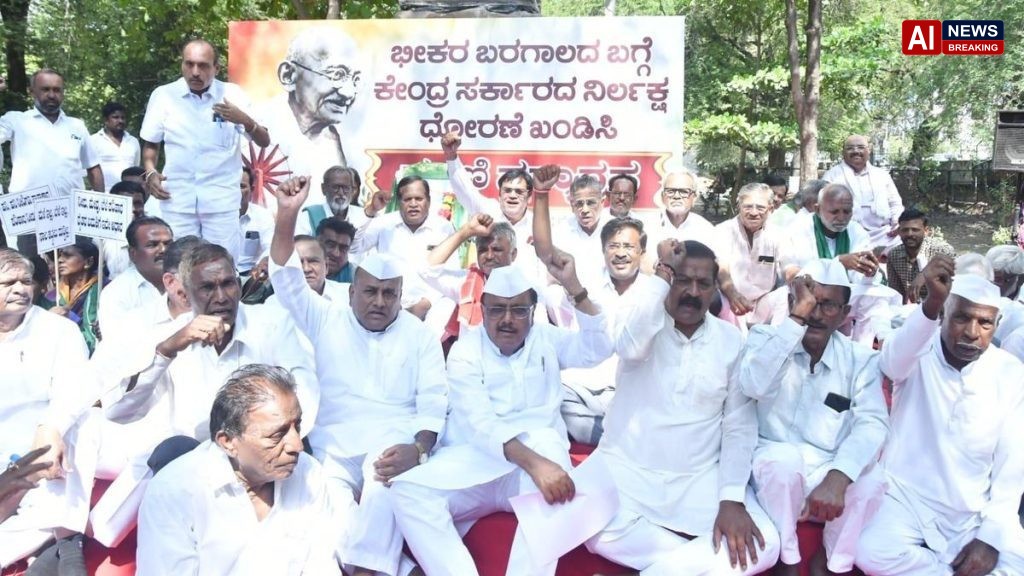
MLA, farmers protest Centre’s ‘failure to release drought relief’ in Karnataka - AI News Breaking
farmers protest centres failure:
MLA, farmers protest Centre’s ‘failure to release drought relief’ in Karnataka KARADH (BBC) – A group of Karnataka legislators and thousands of drought‑stricken farmers descended upon the state capital yesterday, demanding the swift release of ₹22,400.58 crore promised by the central government for 226 taluks hit by prolonged water shortages. The protest, organised by the Karnataka Pradesh Congress Committee (KPCC), began at 10 a.m. outside the State ariat and culminated in a sit‑in that lasted nearly five hours..
The MPs cited a lack of transparency and delays in the disbursement process as the primary grievance, arguing that the funds have been earmarked for irrigation, drinking water and rural livelihoods. The central government, represented by a senior ministerial aide, held a press conference at 3 p.m. to address the escalating tensions..
While acknowledging the delay, the aide emphasised that the allocation had been approved in the 2023–24 budget and that the disbursement mechanism was still pending due to administrative bottlenecks. “The central machinery is working within the statutory timelines,” the aide said, urging the opposition to exercise patience. Critics, however, pointed out that similar allocations in other states had already been released, raising questions about regional bias..
According to the Karnataka High Court, the delay in releasing the relief funds has resulted in a measurable decline in crop yields across the affected taluks. The court’s report, submitted last week, highlighted that the lack of irrigation infrastructure—specifically the failure to construct new canals and revive existing water bodies—has forced farmers to abandon cash‑crops in favour of low‑yield subsistence farming. “The government’s inaction is not merely a bureaucratic issue; it translates into tangible losses for millions of rural households,” the report warned..
In the heart of Bangalore, a coalition of farmer unions—led by the Bharatiya Kisan Union (BKU) and the Karnataka Farmers’ Association (KFA)—held a rally that attracted around 10,000 participants. The crowd chanted slogans demanding “immediate release, no delays,” while waving placards bearing images of parched fields and broken irrigation canals. The rally’s organiser, MK Rao, accused the state government of being complicit in the central delay, stating that state officials had repeatedly failed to follow up on the funds’ release..
The Karnataka Assembly witnessed a heated debate following the protest. Kumar, defended the state’s role, stating that the allocation was already released to the state accounts in 2022. He alleged that “the central bureaucracy is still mulling over the paperwork.” Meanwhile, the Leader of Opposition, P..
Rajasekhar, seized the moment to highlight that the central ministry’s office in Bangalore had not received any communication regarding the disbursement, suggesting a possible administrative oversight or intentional neglect. The central Ministry of Rural Development, which oversees the allocation, stated that the funds were earmarked under the “Drought Relief Scheme – 2024” and would be released once the state completed a mandatory audit. The audit, conducted by the Comptroller and Auditor General (CAG), is scheduled for next month..
The CAG’s audit report, released last month, pointed out that the audit of the funds was pending due to a lack of necessary documentation from the state. This has compounded the delay, as the central government insists on audited accounts before disbursement. Meanwhile, a separate protest organized by the Karnataka Irrigation and Development Board (KIDB) attracted 5,000 participants in Mysuru..
The board’s chairman, B. Shankar, highlighted the chronic underinvestment in irrigation infrastructure over the past decade. He said, “The drought relief money, if released, could transform 226 taluks, but the current delay is turning a once‑promising opportunity into a lost cause.” The protest ended with a pledge to file a legal complaint against the central ministry for failing to honour its commitment..
On the economic front, agricultural economist Dr. Anjali Rao, based at the Indian Institute of Management, Bangalore, warned that the delay in relief could push an estimated 1.5 million farmers into debt. She noted that the average debt per farmer in drought-affected districts has increased by 22% over the past two years..
“We are witnessing a credit crunch in rural areas,” she said, adding that the government’s delayed response could exacerbate poverty and trigger migration from rural to urban centers. The Indian Farmers’ Union (IFU) issued a statement calling the protest “a necessary step to bring the issue into the national spotlight.” The IFU’s spokesperson, Satish Gupta, said the protest was a “peaceful demonstration of civil disobedience” aimed at ensuring that the promised funds reach the intended beneficiaries. “The government can’t keep this promise in a vault and wait for the rains,” Gupta said, pointing to the 2023 monsoon failure that had already devastated the region..
In a move that surprised many, the central government’s finance ministry released a statement clarifying that the ₹22,400.58 crore allocation had been earmarked for 2024–25, but the “implementation window” had not been formally opened. The finance ministry’s spokesperson, N. Ravi, emphasised that the allocation was “subject to the passage of the annual budget and the approval of the fiscal panel.” Critics argued that this technical explanation was a stalling tactic rather than a genuine reason for delay..
The protests continued into the evening, with a sit‑in at the State ariat that was eventually dispersed by police after a heated exchange between the demonstrators and law enforcement..
Updated: November 12, 2026
The stalled release of ₹22,400 crore is not a bureaucratic hiccup but a political failure that will deepen rural debt and fuel urban migration, turning drought into a long‑term economic crisis.
If the central machinery remains shackled by audit delays, Karnataka’s farmers may become a cautionary tale of how governance paralysis can turn a modest relief fund into a catalyst for agrarian distress and social instability.






