
 Pakistan’s leaders hail first astronaut aboard Chinese craft: ‘Proud one of us has gone into space’
 British tourist travels 29 hours from Mumbai to Amritsar for ₹5,461, rates Indian Railways 10/10 | Viral video
 The Supreme Court will decide whether assault weapons bans violate the Second Amendment
 A Critic of Beijing Falls Short in Taiwan’s Key Mayoral Election
 EPA says no rise in contamination after Army detonates lead azide stockpile in Iowa
SFI activists booked for protesting against Minister at Maharaja’s College in Keralam’s Kochi granted anticipatory bail
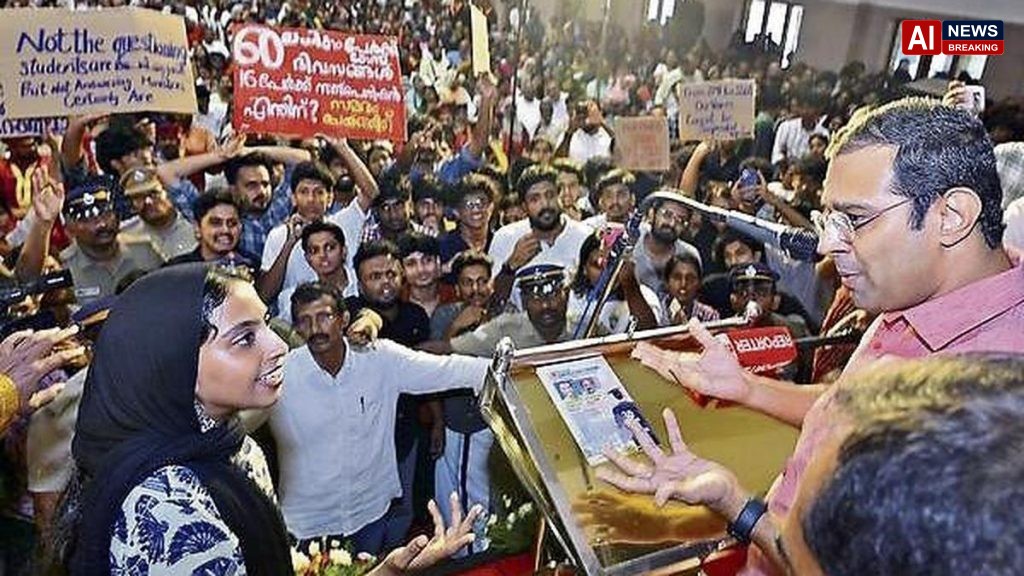
SFI activists booked for protesting against Minister at Maharaja’s College in Keralam’s Kochi granted anticipatory bail - AI News Breaking
activists booked protesting against:
In the bustling campus of Maharaja’s College in Kochi, a group of students from the Student Freedom Initiative (SFI) found themselves at the centre of a legal dispute after they staged a protest against a visiting minister. The protest, which had taken place on the morning of 12 March, drew attention to the perceived lack of transparency in the ministry’s recent decision to allocate funds to the college. The students, who were holding placards and chanting slogans, were arrested by campus security officials on grounds of public order offences..
They were subsequently charged under the Indian Penal Code and the Prevention of Crimes Act for alleged disorderly conduct and incitement to violence.The police report filed by the local police station described the incident as a “public disturbance” that threatened to disrupt academic activities and endanger the safety of faculty and students. According to the police narrative, the SFI members had used loudspeakers to broadcast their demands and had allegedly vandalised college property. The officers claimed that the protest had escalated when a minority of the demonstrators entered a faculty office, forcing the security personnel to intervene..
The police claim that the protest was not a mere peaceful demonstration but an attempt to intimidate the administration and create chaos on campus.In contrast, the students’ own statements paint a picture of a disciplined protest. In an interview conducted by the college’s internal affairs office, the SFI president, Arjun Nair, stated that “the demonstration was organised in compliance with college rules and was purely aimed at raising awareness about the funding decision.” He added that the group had requested permission from the college administration and had been granted a designated area for the protest. According to the students, the protest was interrupted by the sudden arrival of college security forces, who used loudspeakers and physical force to disperse them..
The students claim that their demands were met with intimidation and that they were subsequently arrested without due process.The legal proceedings began when the police filed a criminal complaint, and the case was transferred to the local court. The court, after hearing preliminary arguments, ordered the arrest of the seven SFI members involved in the protest. The defendants were held in custody pending trial, with the presiding judge highlighting that the offence “could not be regarded as a trivial act of dissent.” The court also emphasised that the defendants must remain available for investigation and that any bail granted would be conditional.In a surprising turn of events, the court granted anticipatory bail to the arrested SFI activists on 20 March..
The bail order was issued by the High Court in Ernakulam after a petition was filed by the students’ legal counsel. The petition argued that the arrests were a misuse of power and that the protest was a legitimate exercise of the right to freedom of expression. The court, in its order, stipulated that the bail was conditional on the activists’ cooperation with the investigation and their appearance at any summons issued by the investigating officer.The court’s decision has been welcomed by many civil society organisations and political parties that see the case as a litmus test for the protection of civil liberties..
The Kerala Union of Civil Liberties (KUCL) issued a statement saying that “the granting of anticipatory bail demonstrates that the judicial system is willing to consider the rights of citizens to express dissent.” Meanwhile, the Kerala State Congress Party, which holds a majority in the state legislature, called for an inquiry into the conduct of the police during the protest. The party’s spokesperson, Rajesh Menon, said that “the authorities should investigate whether the police followed proper protocols during the arrest of the students.”Opposition to the bail decision came from the local law enforcement union. In a press conference, the chief of the Kerala Police Association said that “the police act was in line with the law and that the activists had been charged with serious offences.” The union’s statement also called for a “strict scrutiny of the court’s decision, which could embolden lawless protest.” The union added that the police had a duty to maintain order on campus, especially when the protest threatened to spill over into faculty offices and the academic schedule.The case also about the balance between academic freedom and public order..
Maharaja’s College, a historically significant institution, has long been a hotbed of political activism. In recent years, the college has seen an uptick in protests demanding increased transparency in funding and governance. The college’s administration has responded by tightening security measures, citing concerns over campus safety..
The college’s principal, Dr. Menon, said that the administration had a responsibility “to ensure that academic activities continue without disruption.” In response, the students argue that the college’s response has been heavy-handed and has stifled their ability to express grievances.The legal argument presented by the SFI’s counsel focused on the constitutional guarantees of freedom of speech and assembly. The counsel argued that the protest had taken place in a public area, that the demonstrators had not threatened violence, and that the police action constituted a disproportionate response..
The counsel also highlighted that the activists had complied with the court’s bail conditions and were willing to cooperate with the investigation. The court, however, emphasised that the bail was conditional and that the defendants were required to surrender to the police at any time for questioning.In the aftermath of the bail decision, the campus community has been divided. Some faculty members have expressed concern that the incident could create a culture of fear among students who wish to raise legitimate concerns..
Others, however, view the protest as a necessary act of political engagement. The college’s student council has called for a forum to discuss the incident and to develop a framework for peaceful protest that respects both student rights and campus security.The case is expected to proceed to the trial court, where the prosecution will present evidence regarding the alleged offences. The defence, meanwhile, will argue that the arrests were an infringement on civil liberties and that the protest was conducted in a peaceful manner..
The outcome of the trial could have significant implications for how student protests are handled in Kerala and across India. It could also serve as a precedent for future cases involving student activism, public order, and the right to protest in academic settings.Ultimately, the case highlights the tension between the state’s responsibility to maintain order and the individual’s right to dissent. The anticipatory bail granted to the SFI activists is a reminder that the courts are willing to intervene in situations where civil liberties may be at risk..
Whether the investigation will lead to a conviction remains to be seen. In the meantime, the debate over student protest rights, campus security, and judicial oversight continues to intensify..
Updated: November 12, 2026
This development highlights evolving dynamics and may have broader implications in the near term.






