Pakistan’s leaders hail first astronaut aboard Chinese craft: ‘Proud one of us has gone into space’
 British tourist travels 29 hours from Mumbai to Amritsar for ₹5,461, rates Indian Railways 10/10 | Viral video
 The Supreme Court will decide whether assault weapons bans violate the Second Amendment
 A Critic of Beijing Falls Short in Taiwan’s Key Mayoral Election
 EPA says no rise in contamination after Army detonates lead azide stockpile in Iowa
Witkoff and Kushner urge Putin to include Europe in
**
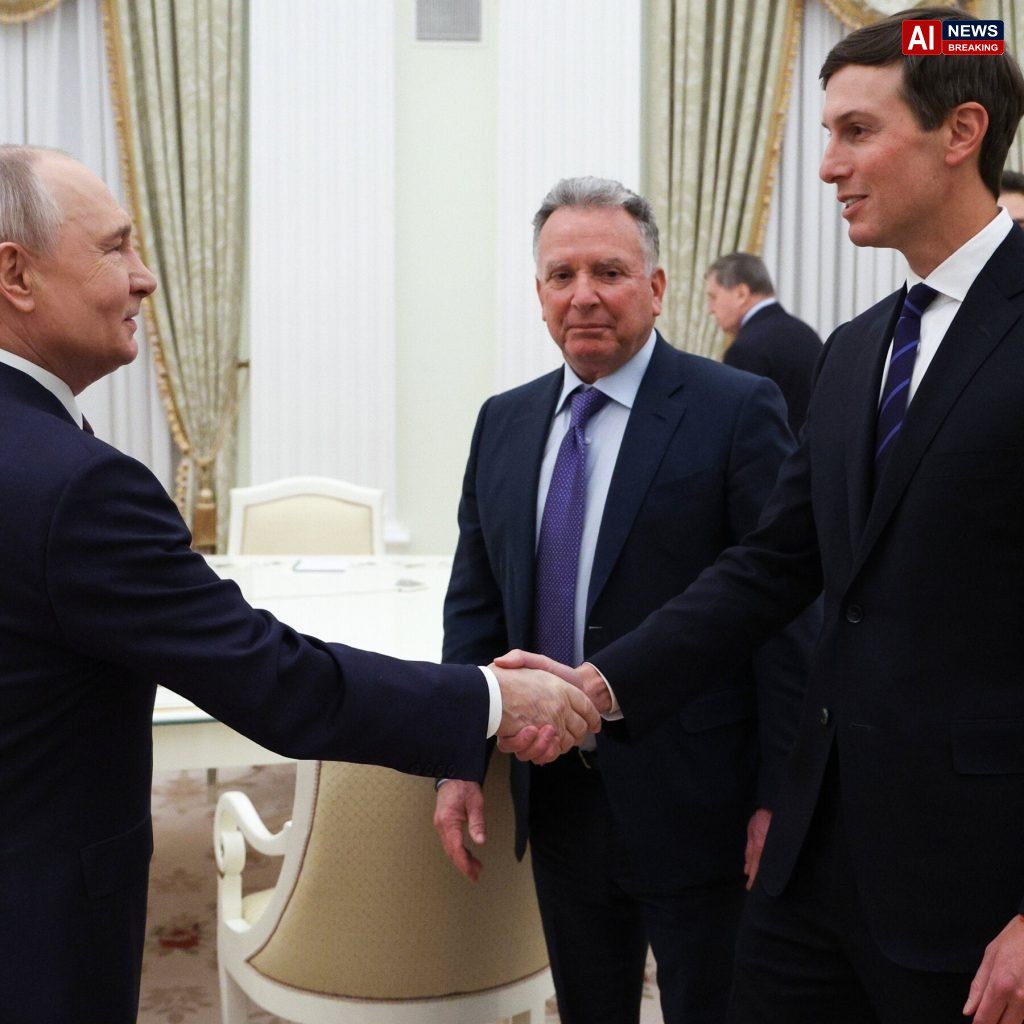
In Moscow, Witkoff and Kushner Ask Putin to Include Europe in Peace Talks - AI News Breaking
witkoff kushner urge putin:
In Moscow, Witkoff and Kushner Ask Putin to Include Europe in Peace Talks The Kremlin has taken a hard line in recent weeks, insisting that any lasting settlement of the Ukraine conflict must go beyond the battlefield and address the wider architecture of European security. In a move that has raised eyebrows in diplomatic circles, two prominent American businessmen – real‑estate magnate Jared Witkoff and former senior adviser Jared Kushner – flew to Moscow in an unofficial capacity to press President Vladimir Putin for a broader dialogue. Their visit, organised by a back‑channel think‑tank, aims to persuade the Russian leader to open negotiations that would involve the European Union, NATO and the United Nations, rather than limiting talks to a bilateral ceasefire..
Witkoff, whose company has long pursued high‑profile development projects in Russia, told Russian officials that the United States is “ready to back a European‑wide security framework” if Moscow agrees to a credible de‑escalation plan. He highlighted the economic costs of a protracted war, noting that sanctions have already cost Russian firms an estimated $150 billion in lost revenue. By framing the issue as a matter of mutual prosperity, Witkoff hopes to create a commercial incentive for Moscow to consider a more inclusive peace process..
Kushner, who served as senior adviser to former President Donald Trump, brought a different angle to the discussions, emphasising political legitimacy and the need for a “new security architecture” that recognises the interests of both Eastern and Western Europe. In a series of private meetings with senior Kremlin officials, he argued that the current NATO expansion model fuels Russian insecurity and that a re‑balanced security arrangement could pave the way for a durable ceasefire. Kushner’s involvement underscores how former political insiders are still being tapped for back‑channel diplomacy in the conflict..
Both men were escorted to a secure meeting room at the Foreign Ministry, where they were joined by Russian Deputy Foreign Minister Sergei Ryabkov and a senior EU diplomat on a “special mission”. The talks lasted for nearly three hours, during which the Americans presented a draft outline that called for a phased withdrawal of Russian forces, a UN‑monitored demilitarised zone and the establishment of a European Security Forum to replace the existing NATO‑EU framework. While the draft was deliberately vague, it signalled a willingness to discuss the status of the Crimean Peninsula and the future of the Donbas region within a multilateral context..
Russian officials responded with cautious optimism, acknowledging that the current deadlock cannot be resolved without broader participation. A senior Kremlin source, speaking on condition of anonymity, said that “the idea of a European Security Forum is intriguing, but it must not undermine Russia’s strategic interests”. The source added that Moscow would consider any proposal that guarantees a “balanced” approach to missile deployments and that respects Russia’s “legitimate security concerns”..
The United States government has not officially endorsed the private initiative, and State Department spokespeople have reiterated that any peace talks must be conducted through recognized diplomatic channels. officials have privately praised the effort as “constructive” and have indicated a willingness to review the proposals if they gain traction in Moscow. This tacit approval reflects a broader U.S..
strategy of leveraging non‑governmental actors to break diplomatic impasses, a tactic that has been employed in other protracted conflicts. European leaders, meanwhile, are watching the developments with a mixture of hope and scepticism. German Chancellor Olaf Scholz warned that “any peace framework must be anchored in the rules‑based international order” and stressed that the EU will not compromise on the sovereignty of Ukraine..
France’s foreign minister, Catherine Colonna, echoed these concerns, stating that “European security cannot be reshaped without a clear commitment to the territorial integrity of all states”. Both officials, however, acknowledged that a broader dialogue could create the conditions for a more comprehensive settlement. Analysts point out that the involvement of high‑profile businessmen could be a double‑edged sword..
On one hand, their personal connections and financial clout may open doors that official diplomats cannot. On the other, their lack of formal authority may limit the weight of any proposals they put forward. Professor Elena Miroshnikova of the Moscow Institute of International Relations warned that “informal talks risk being sidelined if they do not translate into concrete diplomatic moves”..
She added that the Kremlin’s hard‑line stance could also be a negotiating tactic aimed at extracting concessions on sanctions. The Kremlin’s push to broaden negotiations aligns with a recent statement by President Putin, who called for a “re‑examination of the European security architecture” in a televised address. He argued that the current system, dominated by NATO, fails to address the legitimate concerns of Russia and its neighbours..
By framing the issue as a collective European problem, Putin hopes to dilute the narrative that the war is solely about Ukraine’s western alignment. Critics, however, view the rhetoric as a ploy to legitimise Russia’s continued military presence in contested territories. In the background, the war in Ukraine continues to exact a heavy toll on civilians..
The United Nations reports that over 8 million people have been displaced, while infrastructure damage in the east alone exceeds $30 billion. Humanitarian agencies warn that a prolonged stalemate will exacerbate food insecurity across the continent. The urgency of finding a diplomatic outlet has therefore become a rallying point for both Western governments and humanitarian organisations, who argue that a “com.
By pulling in influential business and political actors, the U.S. signals that hard‑talk diplomacy still feels out of reach for Moscow, yet the Kremlin’s cautious openness hints that it may be willing to trade sanctions relief for a broader, less confrontational settlement. The move also reflects Europe’s growing impatience