
 Pakistan’s leaders hail first astronaut aboard Chinese craft: ‘Proud one of us has gone into space’
 British tourist travels 29 hours from Mumbai to Amritsar for ₹5,461, rates Indian Railways 10/10 | Viral video
 The Supreme Court will decide whether assault weapons bans violate the Second Amendment
 A Critic of Beijing Falls Short in Taiwan’s Key Mayoral Election
 EPA says no rise in contamination after Army detonates lead azide stockpile in Iowa
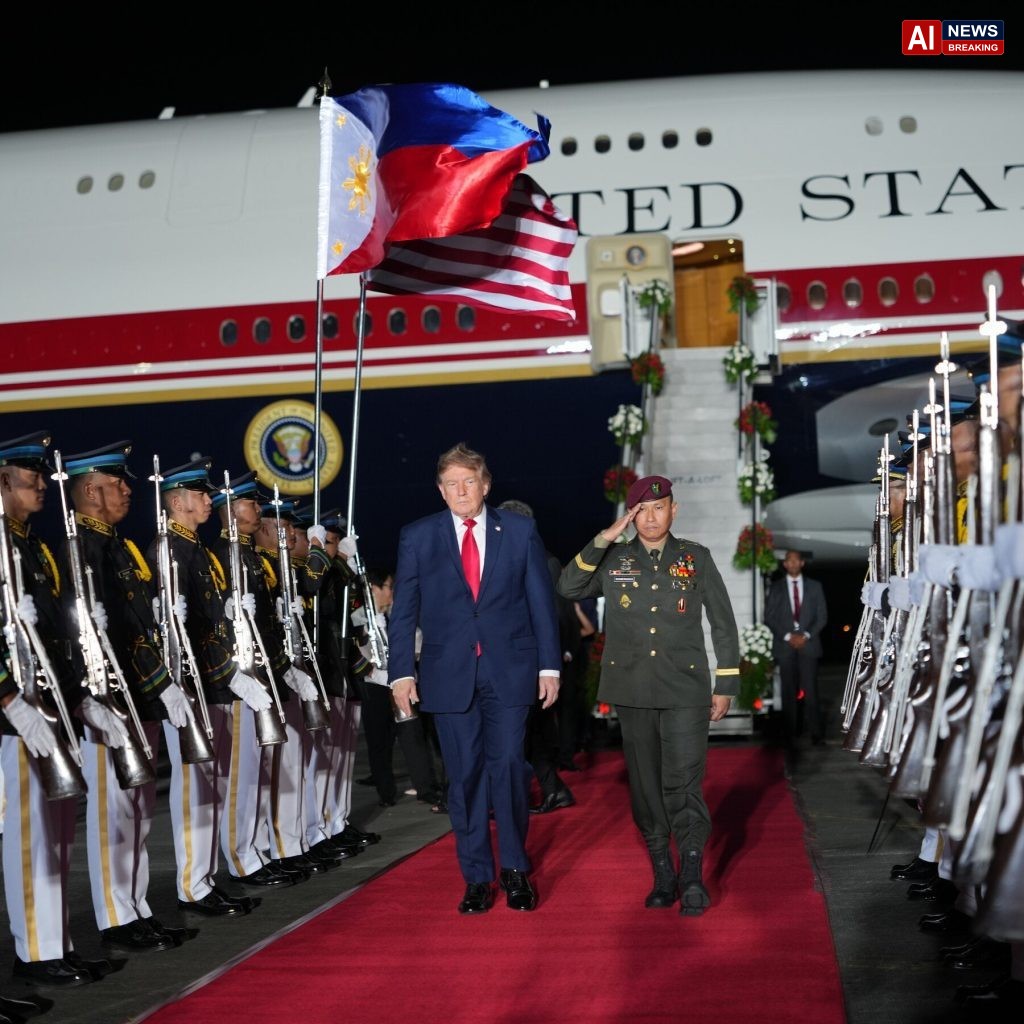
Trump arrives in Manila to meet Philippine leaders
**
Trump arrives in Manila to meet Philippine leaders - AI News Breaking
trump arrives manila meet:
President Donald Trump arrived on Manila’s Ninoy Aquino International Airport with the fanfare customary to any former U.S. president visiting the region. The 78‑year‑old ex‑businessman‑turned‑politician, accompanied by a small contingent of aides and a convoy of luxury vehicles, was greeted by Philippine President Ferdinand Marcos Jr..
and his wife, Imelda, as well as a host of local dignitaries and members of the Filipino-American community. The ceremony, which lasted roughly an hour, was a mixture of protocol and spectacle: a brass band, a 21‑meter‑tall banner proclaiming “Welcome, Mr. President,” and a flurry of cameras capturing every angle..
The first stop in Asia was, as expected, a chance to reinforce ties with the Philippines, a key U.S. ally in a region that has become a pivot for American strategic interests.The day that followed was packed with meetings aimed at solidifying the U.S. presence in Southeast Asia..
Trump first sat down with the Philippine Defense ary to discuss the continued cooperation on maritime security and counter‑terrorism initiatives, an issue that has gained prominence amid rising tensions in the South China Sea. The former president pressed the idea of a joint U.S.‑Philippine military exercise that would incorporate new drone technology, a suggestion that was met with a cautious nod from the Philippine side. This meeting was followed by a session with the Philippine Finance Minister, where the focus shifted to trade and investment..
Trump highlighted the need for a free trade agreement that would open up U.S. markets to Philippine goods while allowing the U.S. to access the growing Southeast Asian consumer base.As the Philippine leg of the trip closed, the next destination was Singapore, a city that has long served as a strategic hub for the United States..
On arrival, Trump was welcomed by the President of Singapore, who introduced him to the city’s skyline and its bustling business district. A series of briefings followed, covering topics ranging from cybersecurity to climate change. Trump made it clear that the United States remained committed to ensuring Singapore’s role as a “digital free‑trade zone” and an essential partner in the broader Indo‑Pacific strategy..
The former president’s remarks were noted for their emphasis on protecting intellectual property rights and ensuring a level playing field for U.S. tech firms operating abroad.The trip’s final stop was the Republic of China, commonly known as Taiwan. This visit, which took place amid a highly sensitive geopolitical environment, was seen as a bold signal of continued U.S..
Trump arrived at the presidential palace in Taipei, where he was received by President Tsai Ing‑wen and her administration. The former president delivered a brief speech in which he reiterated the United States’ commitment to Taiwan’s security and called for a “robust economic partnership” that would help counter China’s influence. The speech was followed by a meeting with the Taiwanese Defense Minister, during which both parties discussed the possibility of a new arms sale that would enhance Taiwan’s self‑defence capabilities.In each country, Trump was accompanied by a small, tight‑knit group of senior advisers and press officers..
The entourage moved in a well‑coordinated manner, with the president’s convoy cutting across city streets in a display of American power and modernity. In the Philippines, Trump’s arrival was met with an enthusiastic crowd that carried banners in both English and Filipino, a testament to the country’s long‑standing relationship with the United States. In Singapore, the president’s arrival was met with a more subdued reception, reflecting the city’s preference for measured diplomacy..
In Taipei, the audience was visibly nervous, aware of the delicate balance that the U.S. must maintain in its relationship with China and the Republic of China.Throughout the trip, Trump’s public appearances were carefully scripted. His statements on the sidelines of press conferences were tailored to appeal to domestic audiences while also addressing international concerns..
He praised the “strong friendship” between the United States and each host country and underlined the importance of “mutual prosperity.” The former president also took the opportunity to remind the world of the United States’ commitment to countering the rising influence of China in the region. These remarks were delivered in a tone that was both assertive and reassuring, a strategy that is common to modern political diplomacy.The logistics of the trip were equally complex. The United States Service assigned a team of 60 to 80 officers to ensure security for the former president and his aides..
The team moved in close coordination with local security agencies in each country, with joint exercises conducted in the lead‑up to the visits. The transportation plan involved the use of a private jet, a convoy of SUVs, and a dedicated press fleet. All of these efforts were aimed at creating a smooth and secure travel experience for the former president, who is known for his insistence on meticulous planning.The trip was also a media showcase..
Television networks from around the world covered each stop, providing live updates and commentary. The former president’s staff released daily updates on Twitter, offering a behind‑the‑scenes look at each meeting. In Singapore, a local newspaper published a front‑page feature that described Trump’s visit as “a significant moment for the city’s global standing.” Meanwhile, in Taipei, an editorial in a local daily highlighted how the trip was seen as a sign of continued U.S..
support for the island’s democracy.In conclusion, President Trump’s short trip to Asia was a blend of political posturing and genuine diplomatic outreach. It was a carefully curated showcase of American influence in the Indo‑Pacific, underscored by a series of meetings that ranged from defense to trade to technology. By visiting the Philippines, Singapore, and Taiwan in quick succession, Trump highlighted the importance of the United States’ strategic partnership with each of these nations, and the continuing relevance of the U.S..
The trip’s overall tone was one of cooperation, even as it reaffirmed the United States’ willingness to confront rising global powers..
Updated: November 17, 2026
Former President Donald Trump landed in Manila, where he met Philippine leaders and outlined plans for deeper defense, trade, and technology ties. He then toured Singapore and Taiwan, underscoring U.S. support for the Indo‑Pacific partnership while signaling a firm stance against China’s growing influence.
Insight: Trump’s whirlwind stop‑over re‑asserts U.S. influence as a counterweight to China, yet the heavy ceremonial flair risks turning strategic goodwill into performative politics. If the message is taken at face value, it signals that America still sees Southeast Asia as a critical frontline, but the reliance on spectacle may undermine long‑term trust among local partners who favor substantive policy over grandstanding.






