A Critic of Beijing Falls Short in Taiwan’s Key Mayoral Election
 EPA says no rise in contamination after Army detonates lead azide stockpile in Iowa
 Israeli Strike Kills 2 Workers at Gaza Clinic, Doctors Without Borders Says
 McQueen Pre-Fall 2027
 Mushfiqur Rahim to retire from Test cricket in February 2027
UK and EU sign trade and youth mobility agreements
**
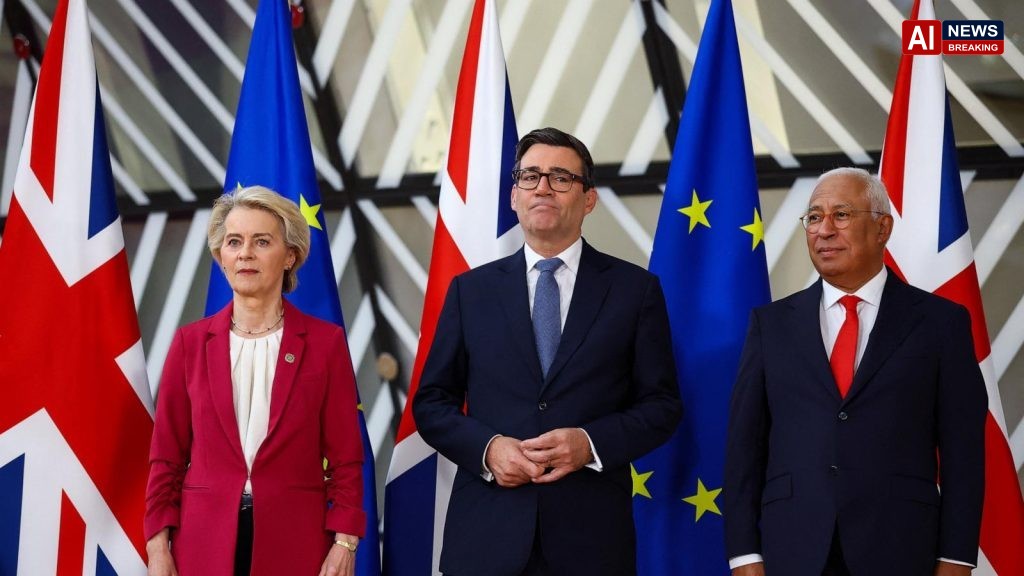
UK, EU agree deals on trade and youth movement, reshaping post-Brexit relationship - AI News Breaking
sign trade youth mobility:
London – The United Kingdom and the European Union have signed two landmark agreements that aim to deepen economic ties and facilitate the free movement of young people across the continent, officials said on Thursday. The deals, concluded after months of intensive negotiations, are described by both sides as the foundation for an “ambitious and dynamic” post‑Brexit relationship, signalling a shift from the confrontational tone that marked the early years of the United Kingdom’s departure from the bloc.The first pact, a comprehensive trade framework, removes many of the remaining tariff and regulatory barriers that have hampered cross‑border commerce since the UK left the EU’s single market in 2020. While the agreement does not restore full market access, it introduces mutual recognition of standards in sectors such as pharmaceuticals, automotive parts and agri‑food products, allowing firms to certify goods once rather than twice..
Traders will also benefit from a streamlined customs declaration system, which the EU Commission estimates could cut clearance times by up to 30 percent for the most heavily trafficked routes between the UK and the continent.In parallel, the youth mobility arrangement creates a new “EU‑UK Youth Mobility Scheme” that will allow citizens aged 18 to 30 to live, work and study in each other’s territories for up to two years without needing a traditional work permit. The scheme, which builds on the existing Youth Mobility Scheme that the UK runs for a limited number of partner countries, will initially cover 10,000 places per year, split evenly between British and European participants. Governments say the programme is designed to foster cultural exchange, address skill shortages and give young professionals a smoother pathway to experience life in a different labour market.Both deals were unveiled at a joint press conference in Brussels, where EU trade commissioner Valdis Dombrovskis and UK trade ary Kemi Baden‑Christensen highlighted the “mutual benefits” of the agreements..
Dombrovskis stressed that the trade framework respects the EU’s single market rules while offering the UK a “fair and transparent” route to sell its goods. Baden‑Christensen, meanwhile, framed the youth scheme as a “new bridge” that will help Britain retain talent and give European young people access to the UK’s thriving creative and tech sectors.The agreements come after a series of high‑level talks that were repeatedly delayed by diplomatic spats over fishing rights, state aid rules and the status of the Northern Ireland protocol. Sources close to the negotiations said that the breakthrough was achieved when both sides agreed to a “principle of proportionality” – a commitment to resolve disputes through dialogue rather than litigation, and to keep any retaliatory measures proportionate to the breach..
The EU’s legal services directorate will now draft a set of implementation guidelines, which are expected to be presented to the European Parliament and the UK Parliament later this year.Business groups have welcomed the trade deal, noting that many small and medium‑sized enterprises have struggled with the administrative burden of duplicated inspections and paperwork. The Confederation of British Industry (CBI) issued a statement saying the agreement “offers a pragmatic solution that will boost competitiveness and protect jobs on both sides of the Channel.” Likewise, European trade bodies such as the European Business Association welcomed the mutual recognition provisions, which they said will “reduce costs and speed up market entry for innovative products.”Critics, however, remain sceptical about the depth of the concessions. Some MPs have warned that the trade framework could lock the UK into a de‑regulatory regime that mirrors EU standards, limiting the government’s ability to diverge in areas such as environmental policy or digital taxation..
In Brussels, a faction of eurosceptic MEPs expressed concern that the youth mobility scheme could become a de‑facto work visa, potentially undermining existing labour market protections. Both sides have pledged to monitor the impact of the agreements and to open a formal review after five years.The deals also have geopolitical implications, as the United Kingdom seeks to position itself as a global trading hub while maintaining close ties with its largest neighbour. Analysts note that the agreements may pave the way for further cooperation in areas such as climate change, security and digital standards, where the EU and the UK have overlapping interests..
The new framework could also serve as a model for the United Kingdom’s relationships with other non‑EU partners, demonstrating a willingness to negotiate sector‑specific accords rather than broad‑sweeping free‑trade deals.Implementation will begin in early 2025, with a transitional period that allows businesses and educational institutions to adapt to the new rules. Customs authorities on both sides will receive additional funding to upgrade IT systems, while a joint oversight committee will be established to resolve any disputes that arise under the trade pact. For the youth scheme, participating universities and vocational training providers will be required to register with a new bilateral portal that tracks enrolments and ensures compliance with health and safety standards.As the United Kingdom marks the seventh anniversary of its formal exit from the EU, the two accords signal a maturing relationship that moves beyond the binary of “in” or “out” of the single market..
While the agreements stop short of a full reintegration, they underscore a willingness on both sides to find pragmatic solutions that benefit economies and citizens alike. Observers will be watching closely to see whether the promised “ambitious and dynamic” partnership can survive political changes in London and Brussels and deliver tangible results for the millions of people who trade, work and study across the Channel..
Updated: November 20, 2026
The UK and EU have sealed a trade pact that cuts tariffs and streamlines standards, while also launching a youth mobility scheme allowing 18‑ to 30‑year‑olds to live, work and study across borders for up to two years. Both deals aim to soften post‑Brexit tensions and boost commerce and cultural exchange, though critics warn they may limit future regulatory freedom.
Insight: The new trade framework nudges the UK into a pragmatic “middle ground” where it reaps EU market efficiencies without surrendering full sovereignty, hinting at a future model of selective integration for post‑Brexit Britain.
Meanwhile, the youth‑mobility scheme is less a cultural exchange than a strategic talent