
 Pakistan’s leaders hail first astronaut aboard Chinese craft: ‘Proud one of us has gone into space’
 British tourist travels 29 hours from Mumbai to Amritsar for ₹5,461, rates Indian Railways 10/10 | Viral video
 The Supreme Court will decide whether assault weapons bans violate the Second Amendment
 A Critic of Beijing Falls Short in Taiwan’s Key Mayoral Election
 EPA says no rise in contamination after Army detonates lead azide stockpile in Iowa
A Summit Gives Putin the Win He Craves: Equal Stature With Superpowers
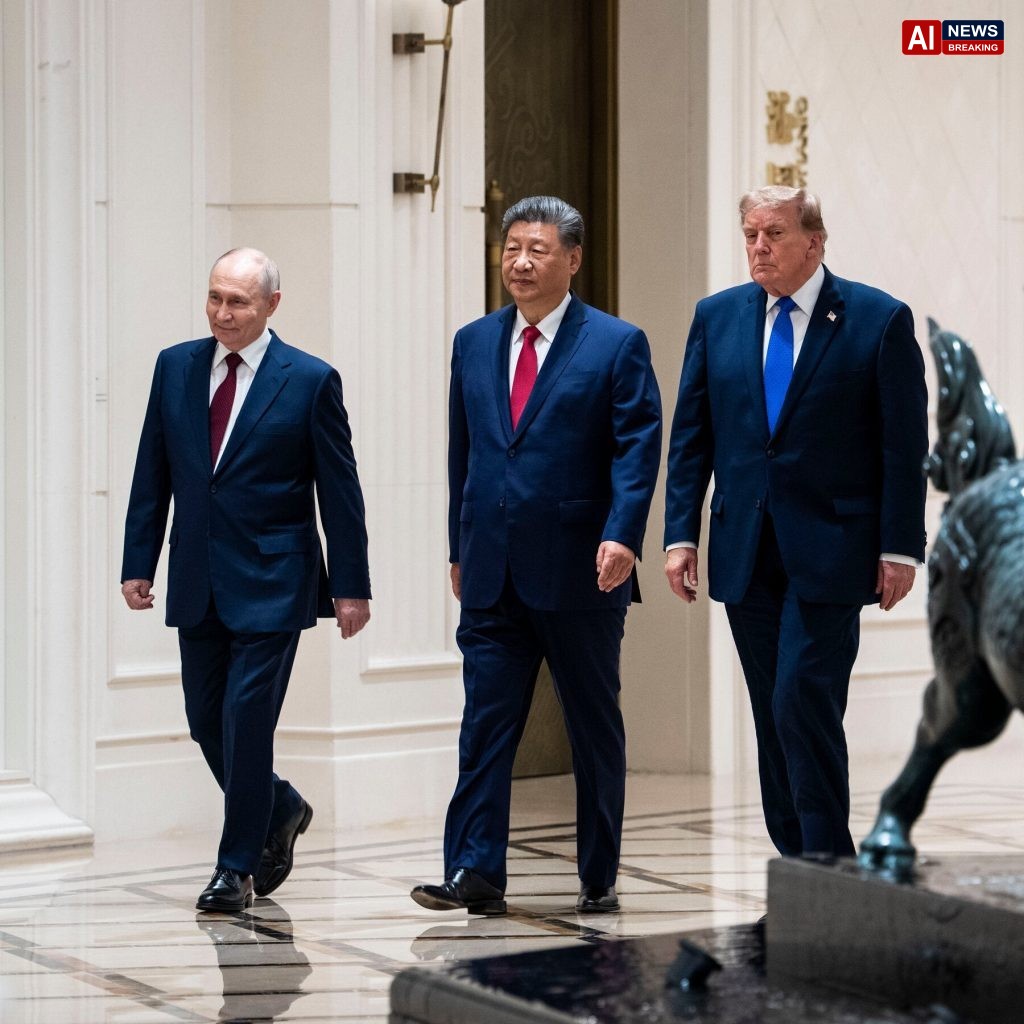
A Summit Gives Putin the Win He Craves: Equal Stature With Superpowers - AI News Breaking
summit gives putin craves:
At the opening of the annual Eurasian Strategic Dialogue in Astana, President Vladimir Putin walked onto the dais beside President Joe Biden and President Xi Jinping, a silent tableau that many analysts interpreted as a triumph of Kremlin diplomacy. The three leaders exchanged handshakes, a gesture that carried more symbolic weight than any policy paper signed in the following sessions. In the wake of the summit, Russian officials have declared the event a “major victory” that underlines Moscow’s equal footing with the United States and China, a narrative that the Kremlin has cultivated over the past decade.The diplomatic scene in Astana, the capital of Kazakhstan, was set against the backdrop of a world still grappling with the fallout of the 2022 invasion of Ukraine..
While Western sanctions have tightened and military aid to Ukraine has expanded, the Kremlin has sought to pivot its foreign policy toward a multipolar world order. The 2023 Eurasian Dialogue was designed precisely to showcase this shift, bringing together leaders from the United States, China, and Russia to discuss a range of issues from energy security to regional stability. In a country where the Russian narrative has often been framed in stark terms—“we are the great power, the rest are chasing us”—the meeting felt like a quiet, calculated victory.The summit’s agenda was intentionally broad..
Delegations debated the future of nuclear non‑proliferation, the security of the Arctic region, and the importance of a stable economic environment for Eurasian trade. In many of these discussions, Putin’s emphasis on strategic autonomy for Russia resonated with both Western and Chinese delegates. He argued that Russia’s security interests could only be guaranteed if it had a genuine seat at the table of global decision‑making, a position that has, historically, been largely dominated by the United States and, increasingly, China.Behind the scenes, the Kremlin’s diplomatic corps had been preparing for months..
The Russian Foreign Ministry had secured the attendance of high‑ranking officials from Washington and Beijing, and the Russian National Security Council had crafted a narrative that framed the summit as a step toward a new global order. The message was clear: Russia is not a fringe actor but a central pillar in shaping international norms. This framing was not merely rhetorical; it was reflected in the policy proposals put forward by the Russian delegation, which called for a re‑evaluation of the existing security architecture in Europe and the promotion of a new “security partnership” that would involve the U.S., China, and Russia.In the hours following the summit, Russian state media highlighted the symbolism of the handshakes..
The Russian news agency TASS ran a front‑page headline that read, “Putin Holds Hand with the Giants, Russia’s Status Confirmed.” The editorial line was unambiguous: Russia has secured recognition as an equal player on the global stage. Meanwhile, the Kremlin’s official website posted a video montage of Putin’s speeches, punctuated by shots of him standing beside Biden and Xi. The imagery of the three leaders together, each holding the flag of their nation, was meant to reinforce the narrative of parity and cooperation.The diplomatic success, however, was not without its critics..
Analysts in Washington warned that the summit was largely ceremonial, with little substantive agreement on the core issues at stake. They pointed out that while the leaders had agreed to a joint statement on “regional stability,” the statement was vague, offering no concrete steps to address ongoing conflicts. The same caution was expressed in Beijing, where officials acknowledged the importance of dialogue but stressed that real progress would require deeper structural changes in international governance..
Nevertheless, both foreign ministries released statements that echoed Russia’s claim of a new partnership that would be “mutually beneficial” and “based on respect for each other’s sovereignty.”The significance of the summit extends beyond its immediate political outcomes. The presence of the United States, China, and Russia on a single platform has implications for the future of international governance. Each of the three nations controls a different sphere of influence: the United States dominates the Western democratic bloc, China leads the global south and has a growing presence in Asia, and Russia retains strategic importance in Eastern Europe and the Arctic..
By bringing these powers together, the summit signalled a potential reconfiguration of global alliances and a shift away from a unipolar world dominated by the United States.In a broader context, the summit also touched on the role of technology and cyber security. The leaders acknowledged the increasing threat of cyber attacks on critical infrastructure and the need for a collective response. While the discussions were limited in scope, they hinted at a possible collaboration that could have far-reaching consequences for international cyber norms..
The United States has been particularly interested in forging a multilateral approach to counter cyber threats, and China’s participation suggests a willingness to cooperate on this front. Russia’s role in this dialogue is less clear, given its history of both cyber attacks and cyber espionage, but it has publicly pledged to comply with international standards.The event also provided a platform for discussing economic cooperation, a key area where Russia has historically sought to expand its influence. The leaders discussed the future of energy markets, the importance of diversification, and the need for a stable price mechanism..
Putin’s emphasis on energy independence for Russia was seen as a strategic counter‑balance to the growing reliance on Western oil and gas. Meanwhile, Biden’s administration highlighted the importance of ensuring energy security for the European Union, while China’s focus was on expanding its supply chains and reducing reliance on any single source.In the months that followed the summit, Russia’s foreign policy team rolled out a series of initiatives aimed at capitalizing on the momentum generated by the event. Moscow has been engaging in high‑level talks with European and Asian partners, focusing on trade agreements and technology exchanges..
The Kremlin’s official statements emphasized a “new era” in international relations, one that would see Russia playing a central role in shaping global norms and policies. Whether these initiatives will translate into tangible shifts in global power dynamics remains to be seen, but the narrative has already been set.The summit’s legacy will likely be measured by the degree to which it changes the perception of Russia in the world. For some observers, the event will be viewed as a calculated diplomatic move that reasserts Moscow’s influence..
For others, it will be seen as a symbolic gesture that has little bearing on the underlying power structures. The United States, for instance, remains wary of Russia’s intentions, especially in light of the ongoing conflict in Ukraine. China’s role is also complex; while the country has been willing to engage with Russia on a range of issues, it has maintained a cautious stance toward direct involvement in the Ukraine crisis.Despite the differing interpretations, one thing is clear: the Eurasian Dialogue has underscored the importance of diplomatic engagement among the world’s largest powers..
Updated: November 20, 2026
This development highlights evolving dynamics and may have broader implications in the near term.






