
 Pond heron found dead in Coimbatore tests positive for avian influenza
 Pakistan’s leaders hail first astronaut aboard Chinese craft: ‘Proud one of us has gone into space’
 British tourist travels 29 hours from Mumbai to Amritsar for ₹5,461, rates Indian Railways 10/10 | Viral video
 The Supreme Court will decide whether assault weapons bans violate the Second Amendment
 A Critic of Beijing Falls Short in Taiwan’s Key Mayoral Election
Ocean liner being sunk to make largest artificial reef
**
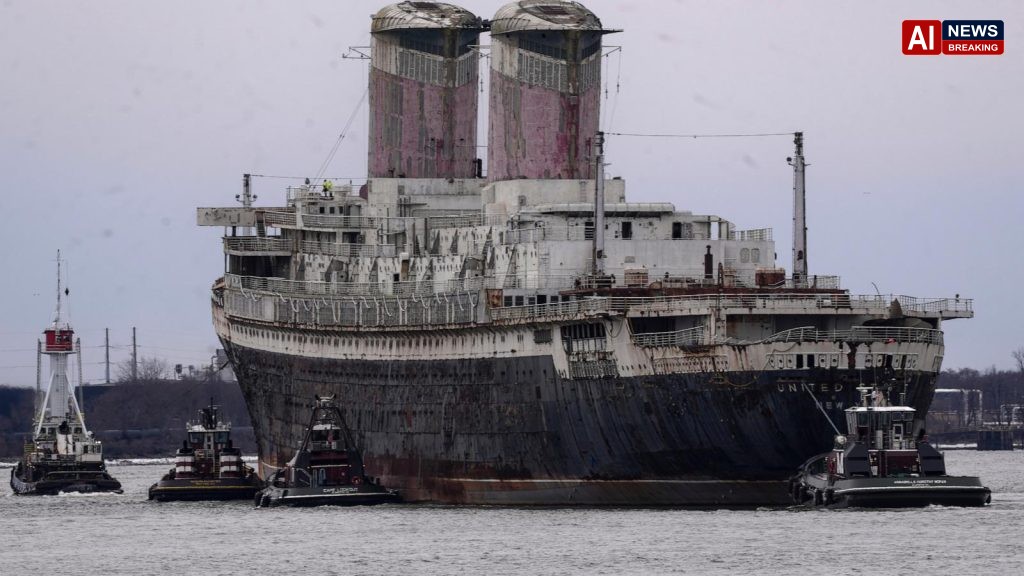
Ocean liner being sunk to make largest artificial reef - AI News Breaking
The historic ocean liner RMS Empress of the Atlantic, celebrated in the 1930s for holding the record as the fastest passenger ship on the transatlantic route, is being prepared for its final descent to the seabed of the Gulf of Mexico, where it will become the core of what officials claim will be the world’s largest artificial reef. The vessel, which spent more than six decades shuttling passengers and later serving as a troop transport during World War II, was decommissioned in 1998 and has since languished in a shipyard on the Gulf Coast, its hull corroded and interiors stripped of valuable fittings.The project, overseen by the Gulf Reef Initiative—a consortium of federal agencies, state environmental bodies and private marine‑conservation groups—has been in planning for nearly five years. It aims to create a habitat that can support an estimated 300 species of fish, corals and other marine life, while also providing a new attraction for divers and a boost to the regional tourism economy..
Fish and Wildlife Service, artificial reefs of this scale can improve local fisheries by up to 30 percent over a decade, as the complex structures offer shelter and breeding grounds that natural reefs cannot always supply in heavily trafficked waters.The Empress of the Atlantic will be towed from the dry dock at Mobile, Alabama, to a designated site roughly 30 nautical miles off the coast of Galveston, Texas, where the water depth reaches 110 feet. Engineers have calculated that this depth strikes a balance between optimal conditions for coral growth and safe access for recreational divers. The sinking operation is scheduled for early next month, contingent on a favorable weather window and the completion of a thorough environmental impact assessment that was submitted to the National Oceanic and Atmospheric Administration earlier this year.Prior to its submersion, the ship will undergo an extensive cleaning process to remove hazardous materials such as asbestos, lead‑based paint, oil residues and any remaining fuel..
Coast Guard has mandated a complete de‑contamination to ensure the reef will not introduce pollutants into the Gulf ecosystem. Specialized contractors will also cut large access points into the hull to facilitate the flow of water and to allow marine organisms to colonise the interior spaces more easily. These modifications are intended to accelerate the natural process of bio‑fouling, wherein algae, sponges and corals adhere to submerged surfaces.Marine scientists from the University of Texas Marine Science Institute will monitor the reef’s development over the next twenty‑five years, tracking biodiversity, water quality and the structural integrity of the wreck..
Their baseline studies, begun last summer, have already recorded a surge in juvenile snapper and grouper populations near the site, suggesting that the presence of the massive steel framework is already influencing local marine dynamics. The data will be shared with international reef‑building programs, many of which are seeking proven models for large‑scale habitat restoration.The financial backing for the venture totals approximately $12 million, a sum sourced from a combination of federal grants, state tourism funds and private donations from maritime heritage societies. Critics have questioned whether the allocation of public money to a single artificial reef is justified, arguing that the funds could be directed toward protecting existing natural reefs that face threats from climate change and overfishing..
In response, proponents contend that the Empress project complements broader conservation efforts by creating a resilient, man‑made alternative that can alleviate pressure on vulnerable natural habitats.Local communities along the Gulf Coast have expressed a mix of enthusiasm and caution. Fishermen’s cooperatives anticipate a potential increase in catch rates as fish congregate around the new structure, while environmental groups stress the need for ongoing monitoring to prevent unintended ecological shifts. The city council of Galveston has pledged to develop educational signage and guided tours that will highlight both the historical significance of the vessel and the scientific rationale behind artificial reef creation.The sinking will be carried out under the watchful eyes of a remote‑operated vehicle (ROV) and a team of divers who will trigger the release of pre‑positioned explosives at predetermined points along the hull..
This method, chosen for its precision, will ensure that the ship settles upright on the seabed, preserving its recognizable silhouette and maximising the available surface area for marine colonisation. After the final blast, the vessel is expected to sink within a matter of minutes, after which the ROV will conduct an immediate post‑sink survey to verify its position and stability.If successful, the RMS Empress of the Atlantic will join an exclusive list of shipwrecks that have been deliberately scuttled to serve ecological purposes, such as the USNS General Hoyt S. Vandenberg off the coast of Florida and the former cargo ship MV Al‑Khalid near Dubai..
However, the scale of this undertaking sets it apart; the Empress measures 900 feet in length and displaces more than 70 000 tonnes, dwarfing its predecessors and promising a reef complex of unprecedented size. The project’s architects hope that the resulting habitat will become a benchmark for future marine‑restoration initiatives worldwide.As the final preparations near completion, the atmosphere among the project’s stakeholders is one of measured optimism. The transformation of a once‑iconic symbol of human engineering into a thriving underwater sanctuary encapsulates a broader shift in how societies view the intersection of heritage and environmental stewardship..
Should the Empress of the Atlantic fulfill its new purpose, it will not only rest beneath the waves as a relic of maritime history but also as a living testament to the potential for reclaimed infrastructure to nurture the planet’s marine ecosystems..
Updated: November 11, 2026
By sinking the RMS Empress of the Atlantic, Gulf‑Coast leaders hope to prove that even the grandest relics of industrial ambition can be repurposed as living infrastructure, turning a symbol of 1930s speed into a new source of biodiversity. If the reef succeeds, it could






